Multi-Facility Parking Management: Platform Requirements for Portfolio Operators
Parking operators managing a portfolio of facilities — whether 5 locations or 500 — face a fundamentally different set of technology requirements than single-facility operators. The complexity compounds across dimensions: more hardware to monitor, more rate structures to manage, more staff to train, more data to consolidate, and more reporting stakeholders to serve.
The technology platforms that serve single facilities adequately often show limitations at portfolio scale. This analysis focuses on the specific requirements that differentiate effective multi-facility parking management platforms from scaled-up single-facility tools.
Centralized Configuration Management
The most operationally significant capability for multi-facility operators is the ability to manage configuration — rates, access control rules, validation programs, operating hours — from a central interface rather than facility-by-facility.
Rate Template Management
Parking rates vary by facility, but large portfolio operators maintain consistent rate structures across facility types (e.g., all airport facilities, all downtown garages, all surface lots). Rate templates allow operators to define a standard rate structure once and apply it across a group of facilities, with facility-specific overrides for exceptions.
Contrast this with the alternative: logging into each facility’s management interface individually to make the same rate change across 20 locations. Manual per-facility configuration is error-prone and labor-intensive. For a portfolio operator running 50 facilities, rolling out a new event pricing tier without a template system requires 50 separate configuration steps — a process that takes days and introduces inconsistency.
Bulk Configuration Pushes
Beyond rate management, bulk configuration should cover: holiday schedule updates, permit type changes, validation program modifications, and equipment maintenance mode activations. Any configuration change that affects multiple facilities should be executable from a single action with facility-specific overrides as needed.
Configuration Audit Trail
In multi-facility environments with multiple administrators, configuration changes must be logged by user, timestamp, and affected facilities. Configuration audits are essential for troubleshooting — “when did this rate change, who made it, and which facilities were affected?” — and for accountability in organizations with multiple operations staff.
Cross-Facility Reporting and Consolidation
Single-facility reporting is the foundation; portfolio reporting is the capability that enables executive decision-making.
Portfolio Dashboard
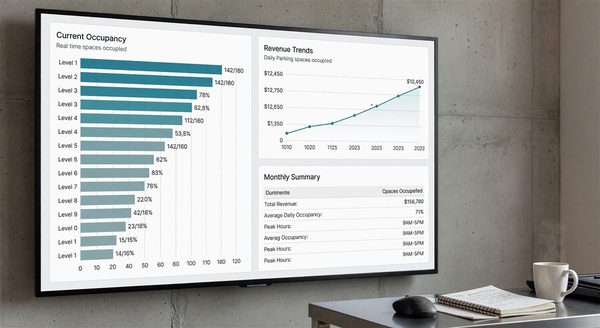
An executive dashboard that summarizes the entire portfolio — total revenue, total transactions, average utilization, top-performing and underperforming facilities — provides the overview that directors and CFOs need without requiring them to aggregate facility-level reports manually.
Key portfolio-level metrics:
- Total revenue (period-to-date, prior period comparison)
- Revenue per facility, sortable by performance
- Total occupancy and utilization across portfolio
- Equipment alerts across all facilities (single-pane visibility)
- Outstanding support tickets and incidents
Cross-Facility Benchmarking
Portfolio operators can compare similar facilities against each other — an analysis that is impossible without cross-facility data in a common schema. Benchmarking metrics might include: revenue per space per month, average transaction value, utilization by hour, payment method mix, help call volume per 1,000 transactions.
Outlier facilities — those significantly above or below portfolio averages on key metrics — warrant investigation. A facility with notably lower revenue per space than comparable locations may have a pricing issue, an operational problem, or an unrealized opportunity for rate adjustment.
Financial Consolidation for Accounting
Finance teams require revenue data consolidated across all facilities in formats compatible with accounting systems. A portfolio operator’s month-end close process depends on accurate, timely revenue data from all facilities. Platforms that require manual export and consolidation create a bottleneck that delays financial close and introduces reconciliation risk.
API-based integration between the parking management platform and accounting systems (NetSuite, SAP, Oracle) automates the consolidation process and eliminates manual data entry.
Centralized Access Control and Permit Management
For portfolio operators with parkers who access multiple facilities — employees parking at any company location, or monthly permit holders with multi-facility access — centralized access control management is essential.
Portfolio-Wide Permit Programs
A permit that grants access to multiple facilities in a portfolio requires credential management that spans all affected facilities. Adding or removing a permit holder must update the access control database at every authorized facility simultaneously. Manual coordination of this update across facility-level systems creates a persistent risk of incomplete deactivation — removed employees retaining access at one or more locations.
Credential Consistency
Portfolio operators benefit from standardized credential technologies across all facilities. If some facilities use 125 kHz prox and others use 13.56 MHz smart cards, credential management becomes complex and multi-facility permits require multiple credential types per parker. Standardizing on a single credential technology (ideally mobile or high-security smart card) simplifies portfolio-wide access management.
Staffing and Workforce Management
Multi-facility operators manage staff across locations, often with staff working at multiple facilities. The technology platform should support:
Cross-facility shift scheduling: Staff scheduling tools that allow scheduling the same employee at different facilities on different days, with appropriate wage and certification management.
Centralized training records: Operator certifications, equipment training, and onboarding completion tracked centrally rather than per-facility.
Incident and exception workflows: When a cash shortage or customer complaint occurs, the escalation workflow should route to the appropriate supervisor regardless of which facility is involved, without requiring separate incident management processes per location.
Disaster Recovery and Business Continuity
At portfolio scale, the consequences of a platform outage extend across all facilities simultaneously. Business continuity planning for multi-facility operators requires:
Offline operation capability: Every facility must continue processing transactions (at minimum, entry and exit with manual payment collection) during platform outages. Lane controllers that store access control logic locally and operate independently of the central platform are the standard approach.
Data backup and recovery: Transaction data generated during an outage must be reconcilable when connectivity is restored. Platforms with robust offline transaction queuing and sync-on-reconnect reduce the financial exposure from connectivity outages.
Redundant cloud infrastructure: Cloud-hosted platforms should specify uptime SLAs (99.9% is common; 99.95%+ is appropriate for revenue-critical operations) and describe the redundancy architecture supporting those commitments.
FAQ
At what portfolio size does a multi-facility management platform become necessary? The breakeven point varies by how homogeneous the portfolio is and how much configuration management is required. Operators with 3–5 facilities managing similar rate structures can often manage with per-facility tools and manual consolidation. Operators with 10+ facilities, complex rate programs, or frequent configuration changes typically find the productivity benefit of centralized management justifies the platform investment.
How should portfolio operators approach system standardization when acquiring new facilities? New facility acquisitions often bring different hardware and software. A standardization plan — defining the target platform and transition timeline — prevents the portfolio from fragmenting into incompatible systems. Hardware replacement timelines tied to natural end-of-life provide cost-effective standardization opportunities without forcing premature replacement of functional equipment.
What is the typical implementation timeline for a multi-facility platform migration? Migrating a portfolio of 10–20 facilities from existing platforms to a new centralized system typically requires 6–12 months when done carefully. Phased migration (moving 2–3 facilities per month) reduces risk compared to simultaneous cutover. Identify and migrate the simplest, lowest-risk facilities first to build team competency before tackling the most complex locations.
How should multi-facility operators evaluate vendor support quality? Request references from operators with comparable portfolio sizes. Ask specifically about support response time for critical revenue-affecting issues and the escalation path when initial support cannot resolve an issue. Evaluate whether the platform provides a named account manager or dedicated support team for portfolio-level accounts, rather than shared general support queues.