Patch Management for Parking Systems: Balancing Uptime and Security in OT Environments
Patch management in parking operational technology occupies a difficult middle ground. Security standards (PCI DSS, NIST frameworks) require timely patching of known vulnerabilities. Operational requirements demand high availability from systems that are actively processing revenue 24 hours a day. And the practical reality of OT environments — systems running end-of-life software, vendor certifications that constrain patch timing, and the risk that patches break operational functionality — creates a tension that purely IT-focused patch management policies do not address.
This article provides a framework for patch management in parking OT environments that balances security requirements with operational realities.
Why Parking OT Patch Management Is Different
IT patch management frameworks assume that patches can be applied on a regular schedule (monthly “patch Tuesday” model, for example) with relatively brief maintenance windows. Servers can be rebooted, applications can be restarted, and the primary concern is deployment logistics.
Parking OT environments introduce complications:
Vendor certification constraints: PARCS vendors often certify their software on specific versions of the underlying operating system and middleware. Applying OS patches before the vendor has tested and certified compatibility may break PARCS functionality or void vendor support agreements. This creates a dependency on the vendor’s patch certification timeline that is often months behind the vendor’s own release of security patches.
Continuous operation requirement: Revenue parking facilities operate around the clock. Planned maintenance windows must be scheduled carefully — typically overnight in low-demand periods — and must be genuinely brief. A failed patch that requires rollback cannot extend a maintenance window past the morning peak entry period.
Limited IT expertise on-site: Parking facility operators often lack the in-house expertise to manage complex patch deployments and rollbacks independently. This creates dependence on vendor support for patch operations, adding lead time.
Legacy hardware constraints: Some parking equipment runs operating systems (Windows XP, Windows 7, older Linux distributions) that are no longer receiving security patches from the OS vendor. In these cases, the patch management question is not “how do we apply patches?” but “how do we compensate for the inability to patch?”
Risk-Based Patch Prioritization
Not all patches carry equal urgency. A risk-based approach prioritizes patches based on:
CVSS Score: The Common Vulnerability Scoring System (CVSS) provides a numerical severity score (0–10) for published vulnerabilities. CVSS 9.0–10.0 (Critical), 7.0–8.9 (High) vulnerabilities affecting in-scope systems should receive the fastest response.
Exploitability in context: A critical vulnerability that requires physical access to exploit is lower priority for a server in a locked equipment room than the same vulnerability in an internet-facing system. Context-adjusted risk accounts for the actual exploit path relevant to the specific deployment.
Exposure: Is the vulnerable component internet-facing? Is it within the PCI DSS scope? Does it process cardholder data or sensitive personal information? Higher exposure increases urgency.
Asset criticality: A vulnerability in a pay station that processes revenue transactions warrants faster response than the same vulnerability in an administrative reporting workstation.
A tiered patch schedule based on these factors:
| Priority | CVSS Score + Context | Target Patch Window |
|---|---|---|
| Emergency | Critical vulnerability, actively exploited, high exposure | 24–72 hours |
| Critical | CVSS 9.0–10.0, internet-facing or payment system | 7–14 days |
| High | CVSS 7.0–8.9, in PCI DSS scope | 30 days |
| Medium | CVSS 4.0–6.9 | 60–90 days |
| Low | CVSS below 4.0 | Next scheduled maintenance |
Compensating Controls for Unpatchable Systems
When patches cannot be applied — due to vendor certification delays, end-of-life systems, or operational constraints — compensating controls reduce risk from unpatched vulnerabilities:
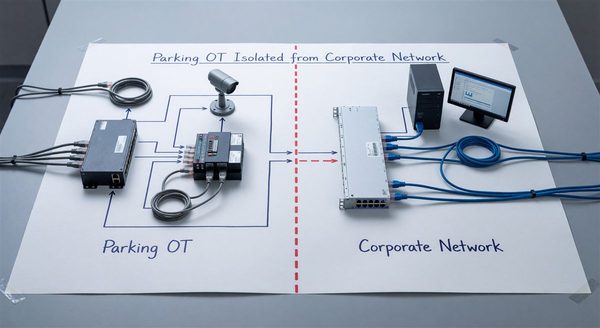
Network isolation: Removing the unpatched system from any network segment with external connectivity reduces the attack surface dramatically. An unpatchable Windows 7 lane controller that communicates only with the PARCS server on an isolated OT VLAN is significantly less exposed than the same system on a network with internet access.
Application whitelisting: Restricting the system to only run specifically authorized executables prevents malware from executing even if it is delivered to the system. Microsoft AppLocker and third-party application control tools provide this capability.
Disable unnecessary services: Removing or disabling network services on the unpatched system that are not required for its operational function reduces the attack surface. Web servers, file sharing services, and unused network protocols should be disabled.
Enhanced monitoring: Deploy IDS/IPS rules that detect exploitation attempts against the specific vulnerabilities that cannot be patched. Alert on indicators of compromise that would signal active exploitation.
Document all compensating controls formally, with justification for why patching is not feasible, for PCI DSS compliance purposes.
Change Management Process
Security patches in OT environments should follow a formal change management process:
Pre-change:
- Document the change, affected systems, and expected impact
- Verify vendor compatibility certification for the patch
- Test in a non-production environment if available
- Schedule the maintenance window with operations management
- Confirm rollback procedure and prerequisites
Change execution:
- Apply patches during the scheduled maintenance window
- Verify system functionality immediately after patching (gate operation, payment processing, access control)
- Document the as-executed changes and any deviations from plan
Post-change:
- Monitor for anomalies for 24–48 hours following patch application
- Close the change record with actual outcome
- Update asset inventory with new patch version
Vendor Patch Notification and Tracking
Maintaining patch currency requires active tracking of vendor security notifications:
Subscribe to vendor security advisories: All PARCS vendors and software component vendors (OS, database, middleware) should have security advisory subscription mechanisms. Subscribe to these for every product in the environment.
CVE monitoring: Monitor the National Vulnerability Database (NVD) for CVEs affecting software components in your parking systems. NVD provides searchable CVE records with CVSS scores and remediation guidance.
Asset inventory prerequisite: Effective patch tracking requires an accurate, current inventory of all software components and versions in the parking OT environment. Without this inventory, it is impossible to assess whether a given CVE affects your systems.
FAQ
How often should parking OT systems be fully patched? PCI DSS requires critical patches to be installed within one month of release for in-scope systems. For operational technology, this timeline is often aspirational given vendor certification delays. Document the actual patching timeline for each system, the reason for any delay, and the compensating controls in place during the delay. This documentation demonstrates diligence in the event of a PCI DSS audit.
What should parking operators do when a PARCS vendor is slow to certify OS patches? Escalate through the vendor support channel, documenting the specific CVE and CVSS score of the unpatched vulnerability. Request a written statement of the vendor’s patch certification timeline. If the vulnerability is critical and the vendor cannot provide a certification timeline, implement network isolation and compensating controls while the vendor works on certification. Consider including patch certification SLAs in future vendor contracts.
Is it appropriate to apply OS patches to PARCS systems without vendor certification? This depends on the specific patch and the risk assessment. Some OS patches address unrelated components with no plausible impact on PARCS functionality and can be applied with reasonable confidence. Others modify core OS components where PARCS may have dependencies. The general principle: test in a non-production environment if possible, document the decision rationale, and verify PARCS functionality thoroughly after applying uncertified patches.
How should parking operators handle end-of-life operating systems in lane controllers? EOL OS on lane controllers is a widespread problem — many controllers installed in the 2010s run Windows XP or Windows 7. The correct long-term answer is hardware replacement. In the interim: strict network isolation (no internet connectivity, no connection to systems outside the OT network), application whitelisting, disabled unnecessary services, and enhanced monitoring. Develop a capital replacement plan with a target date for eliminating EOL OS from the environment.