Incident Response Planning for Parking Facilities: Cybersecurity and Operational Scenarios
Parking facilities are operational technology environments with revenue implications — a system failure or security breach that prevents entry and exit processing can cause immediate, quantifiable financial loss, customer service failures, and potential liability. Yet most parking operators do not maintain documented incident response plans adequate for the range of scenarios they may encounter.
This article covers incident response planning for parking facilities, addressing both cybersecurity incidents (payment system breaches, ransomware, unauthorized access) and operational incidents (system failures, equipment outages, physical security events).
Why Parking Incident Response Plans Are Different
Generic cybersecurity incident response frameworks (NIST SP 800-61, for example) provide a solid foundation but require adaptation for the parking OT context:
Real-time revenue impact: Unlike a back-office data breach that may not be noticed for days, a parking system failure is immediately visible in failed transactions, vehicles stuck at gates, and driver complaints. The “containment and investigation” phase of a standard IR framework may need to run concurrently with “restore operations” rather than sequentially.
Physical safety considerations: Parking facilities are physical environments with drivers and pedestrians. A system failure that leaves gates locked or generates confusing signals creates safety hazards. Incident response procedures must include physical operations protocols, not just IT response steps.
PCI DSS notification requirements: A confirmed or suspected cardholder data breach triggers specific notification timelines to payment card brands (Visa, Mastercard) and acquiring banks, typically within 24–72 hours of confirmation. These obligations are independent of any state breach notification laws and require pre-established relationships with the payment ecosystem.
Incident Classification and Prioritization
Not all incidents warrant the same response urgency. A classification framework helps prioritize resource allocation:
Severity 1 — Critical: Incidents that immediately impact revenue operations or safety
- PARCS system down; gates inoperable or stuck open/closed
- Confirmed payment system breach with active transaction processing
- Ransomware with active encryption of operational systems
- Physical security breach at equipment rooms or counting rooms
Severity 2 — High: Incidents with significant operational impact within hours if unresolved
- LPR system failure causing manual processing backlog
- Pay station failures affecting multiple units simultaneously
- Suspected payment data compromise
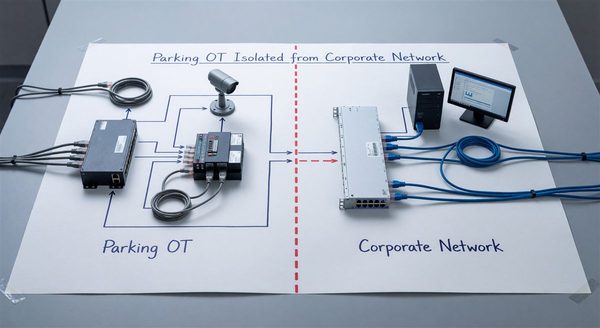
- Network segmentation failure exposing OT to IT network
Severity 3 — Medium: Incidents with operational impact but manageable with workarounds
- Single pay station failure
- Reporting system unavailability
- Non-critical system vulnerabilities requiring expedited patching
- Access control anomalies at non-revenue locations
Severity 4 — Low: Incidents requiring attention but no immediate operational impact
- Failed log collection or monitoring alerts
- Non-critical firmware or software update failures
- Policy violations without operational impact
The Incident Response Lifecycle for Parking
Preparation
Preparation activities that must be completed before an incident occurs:
Contact lists: Documented, current contact information for:
- Internal: operations manager, IT security, facilities, executive sponsor
- Vendor: PARCS vendor emergency support, payment processor, network service provider
- External: PCI forensics investigator (pre-authorized QIR/QIRA on retainer), legal counsel, PR/communications
- Regulatory: Payment card brand security contacts, state breach notification recipients
Fallback procedures: Documented manual procedures for operating each critical function when systems are unavailable:
- Manual gate operation (how to open/close gates without system access)
- Manual fee collection (cash box, rate card, receipt process)
- Manual access list management (printed permit lists)
- Manual count and recording procedures
Evidence preservation: Pre-configured procedures and tools for capturing system state (memory images, log snapshots) before containment actions alter evidence.
Tabletop exercises: Annual tabletop exercises with operations, IT, and management that walk through realistic scenarios — improving response competency and identifying plan gaps before a real incident.
Detection and Analysis
The ability to detect incidents quickly requires monitoring infrastructure:
Security monitoring: SIEM (Security Information and Event Management) or equivalent log aggregation that alerts on anomalous authentication events, network anomalies, and known attack signatures.
Transaction monitoring: Anomalies in transaction patterns (unusual rejection rates, off-hours activity, abnormal transaction values) can indicate both system failures and fraud.
Equipment health monitoring: Real-time equipment status monitoring in the parking management platform that alerts when pay stations, gates, or controllers go offline.
Upon detecting a potential incident:
- Confirm the incident is real (not a false positive or configuration error)
- Classify severity
- Activate appropriate response team
- Begin evidence collection and timeline documentation
- Assess scope (what systems are affected, what data may be involved)
Containment Strategies
Containment decisions in parking OT require balancing security response against operational continuity:
Isolation vs. operation: Isolating a compromised payment system from the network is the correct security response but may take payment processing offline. The decision tree should be pre-documented: at what point does the security risk outweigh the operational disruption? For an active payment card data breach, isolation is mandatory regardless of operational impact.
Segmentation enforcement: If a breach is isolated to one network segment, verify that segmentation controls are preventing lateral movement before focusing exclusively on the compromised segment.
Preserve evidence before action: Log captures and memory images before rebooting or patching compromised systems preserve evidence required for forensic investigation and potentially for insurance claims.
Recovery
Recovery planning for parking systems:
Recovery time objectives (RTO): Define the maximum acceptable downtime for each system. Revenue payment processing: typically 2–4 hours maximum. Full PARCS functionality: 24 hours. Access control for monthly parkers: 8–24 hours.
Recovery point objectives (RPO): Define the maximum acceptable data loss. For financial transactions: zero tolerance. For system configurations: typically within 24 hours.
Backup systems and tested recovery procedures: Backups that have never been tested are unreliable. Quarterly restore tests of critical system backups confirm recoverability and identify degraded backups before they are needed in a crisis.
FAQ
When is a parking operator required to notify customers of a data breach? State breach notification laws vary, but most require notification to affected individuals when personal information (including payment card data) is confirmed to have been accessed by unauthorized parties. The NIST definition of a reportable breach applies different standards than a PCI DSS reportable compromise. Consult legal counsel to understand the specific notification obligations for your jurisdiction and the type of data involved.
What is a PCI forensics investigator and when is one needed? A PCI Forensics Investigator (PFI) is a company qualified by the PCI Security Standards Council to conduct forensic investigations of payment card data breaches. PFIs are required for investigations involving suspected or confirmed payment card data compromises that must be reported to card brands. Engaging a PFI retainer agreement before an incident ensures faster response when one is needed.
How should parking operators handle a ransomware attack that encrypts PARCS systems? Immediate steps: isolate the infected systems from the network to prevent spread; do not pay the ransom (this does not guarantee recovery and may violate OFAC regulations if the attacker is a sanctioned entity); contact incident response counsel and cybersecurity incident response team; initiate recovery from backup if available. Law enforcement notification (FBI IC3) is recommended. Ransomware attacks may also constitute data breaches if the attacker exfiltrated data before encrypting — treat as a potential breach requiring PCI and legal notification evaluation.
How often should parking incident response plans be reviewed and updated? Plans should be reviewed annually at minimum and after any actual incident that reveals gaps. Key triggers for immediate review: significant changes to the technology environment (new systems, major upgrades), changes in key personnel (new IT director, new operations manager), changes in threat landscape (new ransomware variants targeting OT), and changes in compliance requirements (new PCI DSS version, new state privacy laws).