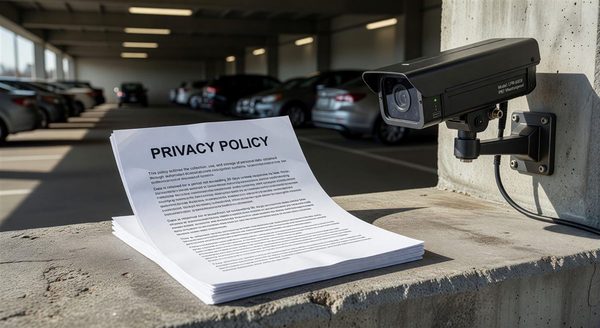
LPR Privacy Policy Litigation: The Technical Compliance Checklist for System Operators
License plate recognition litigation has been building for several years, largely centered on the collection and retention practices around plate-image and associated location data. A newer thread in that litigation landscape shifts the exposure in an important way for operators: rather than requiring a plaintiff to prove actual data misuse, some recent state-court activity has focused on whether an operator posted an adequate, accessible privacy policy disclosing what LPR data is collected and how it’s used — treating the disclosure failure itself as the actionable harm, independent of whether the data was ever misused. Reports describing this shift generally point to California appellate-level activity as an early example, though the exact scope and durability of any specific ruling should be confirmed against current legal counsel and primary court records rather than treated as settled nationwide precedent.
For a systems integrator or parking-technology team, the practical takeaway isn’t a legal opinion — that’s counsel’s job — but a technical one: what does an LPR platform need to actually have in place, at the configuration level, to support a defensible privacy-disclosure posture and reduce the operational risk that this litigation category creates?
Why This Category of Claim Is Different From Prior LPR Privacy Litigation
Earlier LPR-related privacy claims typically required a plaintiff to demonstrate some connection between data collection and an actual harm — a breach, an improper disclosure to a third party, or use beyond a stated purpose. A disclosure-based claim is procedurally simpler for a plaintiff to bring and, in jurisdictions where courts treat the statutory violation itself as sufficient, meaningfully lowers the bar to a viable claim. That combination — lower proof burden plus, in some jurisdictions, statutory per-person damages exposure — is what has elevated this from a background compliance concern to something integrators and operators are being asked about directly by clients and their counsel.
What “Adequate Disclosure” Requires at a Technical Level
A privacy policy is a legal document, but whether an LPR platform can actually support and evidence what that policy claims is a configuration and architecture question. The technical elements that matter most:
Policy-hook infrastructure in the platform itself
The LPR software should have a mechanism to link a facility’s or client’s specific privacy policy to the actual data-handling configuration in effect for that deployment — not a generic disclosure maintained separately from the system that determines actual retention and access behavior. A policy document that describes retention and access practices the running system doesn’t actually enforce is a liability in itself, since a mismatch between stated policy and actual system behavior can be worse evidence than no policy at all.
Data retention configuration that matches the stated retention period exactly
If a privacy disclosure states plate data is retained for a defined period, the system’s retention configuration needs to enforce that period automatically — through scheduled purge jobs, not a manual process someone might forget to run. Operators should be able to demonstrate, on request, that data older than the disclosed retention window does not exist in the system, which requires the retention enforcement to be a verifiable system behavior rather than a documented intention.
Audit logging sufficient to reconstruct who accessed what data and when
Beyond retention, a defensible compliance posture requires the ability to show who accessed plate data, for what stated purpose, and when — not just that access controls exist in the abstract. Audit logs need to capture enough detail to reconstruct an access history if a dispute arises, and that logging needs to cover every access path into the data, including administrative and support access that sometimes bypasses the customer-facing access controls.
Documented data-sharing configuration, including any third-party integrations
Many LPR deployments feed data to law-enforcement partnerships, parking-enforcement contractors, or analytics vendors. Each of those integrations needs its own documented data-flow record showing what data leaves the primary system, to whom, and under what retention and use terms on the receiving end. A privacy policy that discloses data use within the operator’s own systems but doesn’t account for what happens to data once it’s shared with a third-party integration has a gap that a plaintiff’s counsel is likely to focus on directly.
Record-level support for access and deletion requests
Disclosure-based exposure travels alongside a related obligation in several states: an individual’s right to ask what data an operator holds about them and, in some cases, to have it deleted. An LPR platform supports this defensibly when an operator can search records by plate across the full retention window, export what exists in a usable form, and delete a specific individual’s records — including from backups and any downstream integration copies — without dismantling unrelated data. A privacy policy that promises these rights while the platform can only purge in bulk, or cannot reach data already shared with a downstream partner, recreates the same policy-versus-behavior mismatch that disclosure claims are built to exploit. Confirm during deployment that the platform can act on a single-subject request, not only enforce a blanket retention window.
A published, accessible disclosure mechanism at each facility
The underlying legal concern in this litigation category is about whether the public had adequate notice — which means the technical configuration needs to be paired with an actual accessible disclosure mechanism: signage at the facility, a linked privacy policy from any customer-facing app or payment page, and a policy document that’s actually current with what the system does, not a template that was drafted once and never updated as the deployment evolved.
Building This Into a Deployment Checklist
For systems integrators deploying or updating LPR installations, a practical technical checklist to work through with each client:
- Confirm the platform supports facility-specific or client-specific privacy-policy linkage, rather than relying on a single generic disclosure across all deployments if retention or use practices actually differ by site.
- Verify automated retention purge is configured and actually running — request evidence of a recent purge job execution, not just a configuration screen showing an intended retention period.
- Confirm audit logging covers all access paths, including administrative, support, and any automated integration access, not just customer-facing user access.
- Map every downstream data-sharing integration and confirm each has its own documented terms, rather than assuming the primary system’s privacy policy implicitly covers integrations built on top of it.
- Confirm the client has a current, accessible privacy disclosure matching the actual configured system behavior, and flag any mismatch between documented policy and system configuration as a priority remediation item, not a paperwork afterthought.
The Role of the Integrator Versus the Operator
None of this shifts legal responsibility for privacy compliance away from the operator — that responsibility sits with whoever is collecting and using the data. But an integrator that ships a platform capable of supporting these technical requirements, and that flags configuration gaps during deployment and ongoing service visits, is providing a materially more defensible product than one that treats privacy configuration as an afterthought the client is solely responsible for configuring correctly on their own. Given how quickly this litigation category appears to be developing, treating policy-hook infrastructure, enforceable retention, and comprehensive audit logging as standard deployment requirements — not optional add-ons — is a reasonable posture for any LPR platform serving parking operators today.
Frequently Asked Questions
Does this litigation trend mean LPR data itself is now illegal to collect? No — the emerging claims described in recent reporting center on disclosure adequacy, not on the legality of LPR data collection itself. Confirm the current state of law in your specific jurisdiction with counsel, since privacy law in this area is evolving and varies significantly by state.
What’s the single most common technical gap that creates exposure? A mismatch between what a facility’s privacy policy states about retention or data use and what the system is actually configured to do — a policy that promises data deletion after a period, when the system’s retention configuration doesn’t actually enforce that period automatically.
Do third-party data-sharing integrations need their own privacy disclosure? Generally yes — a disclosure covering only the operator’s own primary system doesn’t account for what happens once data is shared with a law-enforcement partnership, enforcement contractor, or analytics vendor, which is often where the gap actually exists.
Is audit logging alone sufficient, or does retention configuration matter equally? Both matter and address different exposure. Audit logging supports demonstrating who accessed data and why if a dispute arises; retention configuration prevents data from existing past its disclosed retention window in the first place. A defensible posture requires both.
Who should lead the compliance review — the integrator or the operator’s legal counsel? This should be a joint effort. Legal counsel determines what the privacy policy must say and what the applicable law requires; the integrator confirms the deployed system’s technical configuration actually matches and can enforce what the policy states.
Further Reading from Authoritative Sources
- International Association of Privacy Professionals (IAPP) — professional resources tracking state privacy law developments relevant to biometric and location-data litigation.
- National Conference of State Legislatures — Privacy Legislation — a tracker of state-level privacy legislation affecting data collection and disclosure requirements.