Parking Occupancy Sensors: Ultrasonic vs. Magnetic vs. Camera-Based
Knowing how many spaces you have is straightforward. Knowing in real time which ones are occupied — and communicating that to drivers, management systems, and guidance displays — is an engineering problem that the parking industry has solved in three materially different ways.
Ultrasonic sensors, magnetic sensors, and camera-based detection each have distinct operating principles, accuracy profiles, installation requirements, and cost structures. Choosing the wrong technology for your facility type will cost you more than just money — it will generate occupancy data you can’t trust, and guidance systems that direct drivers to occupied spaces.
How Each Technology Works
Ultrasonic Sensors
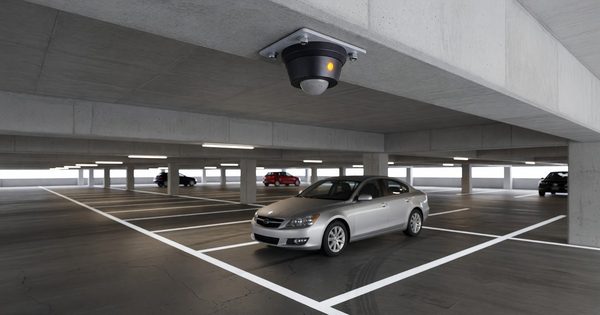
Ultrasonic occupancy sensors mount overhead, typically on the soffit above each parking stall. They emit ultrasonic pulses (typically 40–50 kHz, above human hearing range) and measure the time for the echo to return. When the return time indicates an object at the height of a vehicle roof, the space is marked occupied; when it indicates the floor distance, the space is marked vacant.
The operating principle is simple and the technology is mature. Ultrasonic sensors have been deployed in parking structures since the early 2000s, and the installation and performance characteristics are well-understood.
Key performance variables: Detection zone geometry (the sensor must be positioned to detect the vehicle’s roof consistently, regardless of vehicle size), temperature compensation (the speed of sound varies with air temperature, affecting range calculations), and signal processing algorithms that distinguish vehicle presence from other reflective objects.
Magnetic Sensors
In-ground magnetic sensors detect the disturbance in the Earth’s magnetic field caused by a vehicle’s ferrous metal content. The sensor is embedded in the pavement surface (either cut into an existing slab or poured into new construction) and communicates wirelessly — typically via Zigbee or proprietary RF protocols to an overhead access point.
The operating principle is fundamentally different from ultrasonic: magnetic sensors detect vehicles, not the space they’re in. The detection is based on the vehicle’s electromagnetic signature rather than its physical presence.
Key performance variables: Vehicle detection threshold calibration (pickup trucks and sports cars have very different magnetic signatures), infrastructure environment (rebar in concrete creates baseline magnetic interference that must be calibrated out), and battery life for wireless sensor nodes.
Camera-Based Detection
Camera-based occupancy systems use computer vision algorithms to analyze video from overhead cameras and determine space occupancy. Each camera typically covers 4–8 spaces, with image processing running either on an edge computing device at the camera or in the cloud.
Current-generation camera occupancy systems use deep learning models trained on large datasets of vehicle images across varying lighting, weather, and vehicle type conditions. Detection accuracy in well-designed systems can exceed 99% under normal conditions.
Key performance variables: Lighting conditions (both insufficient light and high-contrast glare challenge camera-based detection), camera positioning and lens selection for the specific space geometry, and processing pipeline latency (the time between a vehicle’s arrival and the system registering the change in occupancy).
Accuracy Comparison
Under Normal Conditions
Under normal operating conditions — clear sightlines, stable ambient conditions, typical vehicle mix — all three technologies can achieve high detection accuracy (>98%). The differences emerge in challenging conditions.
Ultrasonic performs reliably across vehicle types and sizes, handles standard indoor parking environments well, and is relatively insensitive to visual conditions. Accuracy degrades with angled vehicle parking (if a car is parked at a steep angle, the reflection geometry may not return accurately), vehicles parked partially outside the detection zone, and shopping carts or other objects left in spaces.
Magnetic is highly reliable for vehicle detection and largely immune to environmental visual conditions. False positives from large metal objects (shopping carts left in spaces, maintenance equipment) are a known challenge. Battery life management in wireless deployments affects reliability — a sensor with a depleted battery reports incorrect data silently.
Camera-based performs excellently in well-lit, stable conditions and degrades more than the other technologies in challenging visual environments: very low light (late-night operation in structures with inadequate lighting), direct sun creating high-contrast scenes, and unusual weather (heavy snow covering vehicles, heavy rain on lenses).
Edge Cases and Failure Modes
The failure modes differ in ways that matter operationally:
- Ultrasonic systems fail in a recognizable pattern — usually consistent misreads in specific zones that can be diagnosed by space location
- Magnetic sensors may fail silently — a dead sensor battery continues to report last-known state or defaults to vacant, giving no indication of failure
- Camera systems fail visibly — when a camera is offline or its view is obstructed, the occupancy data for those spaces is clearly unavailable
From a monitoring standpoint, camera systems’ visible failure modes are operationally easier to manage. Magnetic sensor failures require active monitoring of battery levels and sensor health status.
Installation Complexity and Cost
Ultrasonic
Installation requires mounting each sensor above its corresponding space, running power (typically PoE or low-voltage DC) to each sensor, and connecting sensors to a network that communicates occupancy status to the management platform.
In new construction, conduit planning for ultrasonic sensor power and data runs is straightforward. In retrofit situations, running cabling overhead through finished garages can be expensive — particularly in multi-level structures with post-tensioned concrete construction that limits drilling.
Per-space hardware cost for ultrasonic systems typically runs $80–$150 for the sensor unit, excluding installation labor and networking infrastructure.
Magnetic In-Ground
Cutting slots in existing pavement for in-ground sensors is disruptive — the facility must be taken out of service during installation, and pavement cutting generates noise, dust, and debris. Battery-powered wireless sensors avoid some of this complexity but introduce ongoing maintenance requirements.
New construction installation is less disruptive: sensors can be placed before concrete pours. But the coordination requirements between the sensor installation and the construction schedule add complexity.
Per-space hardware cost for magnetic sensor systems typically runs $100–$200 for the sensor and wireless gateway infrastructure, excluding installation labor and pavement work.
Camera-Based
Camera-based systems have the lowest per-space installation cost at scale because one camera covers multiple spaces. The infrastructure — cameras, power, network backhaul — is installed in a pattern across the facility rather than at every individual space.
The tradeoff is that camera coverage geometry is less forgiving than per-space sensors. A camera that’s positioned slightly wrong may not cover all of its assigned spaces correctly, and diagnosing coverage gaps requires either on-site visual inspection or analyzing detection data for spaces that show anomalous patterns.
Per-space hardware cost for camera-based systems at scale typically runs $30–$80 when camera coverage ratios and infrastructure costs are fully allocated — making them cost-competitive with per-space technologies for large installations.
Integration and Data Output
All three technologies ultimately produce the same data: a binary or multi-state (vacant/occupied/unknown) status for each numbered space. The integration path to parking guidance systems, management dashboards, and wayfinding displays is similar regardless of sensor technology.
Differences emerge in data richness. Some camera-based systems provide additional metadata with each detection event: vehicle classification (sedan/SUV/truck), dwell time analytics, and in LPR-enabled configurations, plate data that enables reservation-based space assignment. Per-space sensors (ultrasonic and magnetic) generally provide occupancy state only.
For smart parking applications that need space-level reservation, dynamic pricing based on demand patterns, or anomaly detection (vehicles parked beyond permitted duration), camera-based systems with richer data output provide more capability.
Resources like smartparkingworld.org cover the integration between occupancy sensor data and smart city mobility platforms — worth reviewing if your occupancy data needs to feed into broader transportation management systems.
Recommendations by Facility Type
Indoor multi-level structures, moderate throughput: Ultrasonic is typically the best value — mature technology, high reliability, straightforward maintenance, and well-understood installation practices. The incremental cost over camera-based is justified by the simplicity of per-space detection.
Surface lots with low ambient light or extreme weather: Magnetic in-ground sensors are most resilient to the conditions that challenge both ultrasonic (doesn’t apply, it’s above) and camera systems.
Large-scale facilities prioritizing rich analytics: Camera-based systems with computer vision that goes beyond occupancy detection — dwell time, vehicle classification, integration with LPR — provide the highest data ROI for facilities with management teams who will use the analytics.
Facilities with tight retrofit budgets: Camera-based systems often present the lowest installed cost per space at scale, making them attractive for retrofits where per-space cabling runs are expensive.
For in-depth operational reviews from operators who’ve deployed each technology at scale, parkingprofessional.com publishes technology case studies that complement the specification-level comparisons available from manufacturers. The practical commissioning and ongoing management guidance at parkingoperatorhub.com is particularly useful for facilities teams planning sensor deployments.
No single sensor technology is best for every facility. Understanding the operating principles, failure modes, and cost structures of each positions you to make the right choice — and to ask the right verification questions when vendors claim their system works in conditions that technically challenge their detection approach.