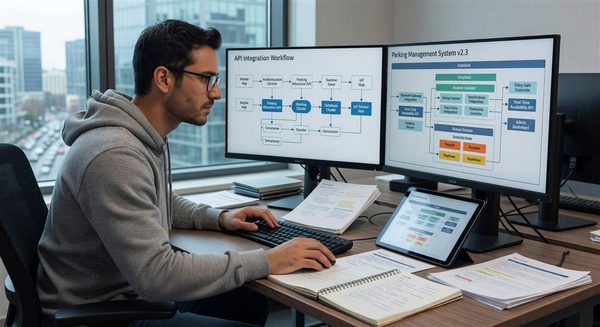
Parking management software has evolved from a simple revenue tracking tool into the operational nervous system of modern parking facilities. The right platform manages access control, processes payments, generates reports, monitors equipment health, and increasingly uses data analytics to optimize pricing and operations. The wrong platform creates operational headaches that compound over years.
The challenge for parking operators is that most software platforms look remarkably similar during a vendor demo. Clean dashboards, impressive reporting, and responsive interfaces are table stakes in 2024. The differences that actually matter — architecture decisions, integration flexibility, data ownership, and long-term cost structure — are harder to see and require asking the right questions.
This article provides a framework for evaluating parking management software that goes beyond the demo experience.
Architecture: Cloud vs. On-Premise vs. Hybrid
The first and most consequential decision is the platform architecture. This choice affects cost structure, scalability, security responsibility, and your long-term flexibility.
Cloud-Native Platforms
Cloud-native platforms run entirely on the vendor’s infrastructure (or a cloud provider like AWS or Azure). Your local equipment connects to the cloud for command and control, data storage, and reporting.
The advantages are genuine: no local servers to maintain, automatic software updates, scalability without hardware investment, and access to reporting and management from any internet-connected device. For multi-site operators, cloud platforms centralize management in a way that on-premise systems cannot match.
The disadvantages deserve equal attention. Cloud platforms depend on internet connectivity. If your facility’s internet connection goes down, what happens? The answer varies by vendor and is one of the most important questions you should ask. Some platforms cache transactions locally and sync when connectivity returns. Others require real-time connectivity for gate operations, meaning an internet outage can shut down your entry and exit lanes.
Data ownership is another consideration. In a cloud model, your operational and financial data resides on the vendor’s infrastructure. Understand the data ownership terms in your contract. Can you export all of your data if you change vendors? What happens to your data if the vendor goes out of business? Is your data isolated from other customers (single-tenant) or shared in a multi-tenant database?
On-Premise Platforms
On-premise platforms run on servers at your facility. You own the hardware, manage the infrastructure, and control the data.
The advantages are independence: no internet dependency for core operations, complete data control, and no recurring cloud subscription fees. For facilities with unreliable internet connectivity or strict data residency requirements, on-premise remains the practical choice.
The disadvantages are operational overhead: server hardware maintenance, IT support requirements, manual software updates, backup management, and the capital cost of server infrastructure. For smaller operators without dedicated IT staff, the on-premise management burden can be substantial.
Hybrid Architectures
Most modern parking platforms offer hybrid architectures that combine local processing for time-critical operations (gate control, payment processing) with cloud services for reporting, analytics, and remote management. This approach captures many of the benefits of both models: operational resilience from local processing and management convenience from cloud services.
Hybrid architectures are the sweet spot for most parking operations, but they add architectural complexity. Evaluate how data synchronizes between local and cloud components, what happens during connectivity interruptions, and how software updates are managed across both layers.
Integration Capabilities
A parking management platform does not exist in isolation. It must integrate with payment processors, access control hardware, LPR cameras, occupancy sensors, accounting systems, and increasingly with building management systems and mobile applications.
Hardware Integration
The platform must support your installed equipment base. This sounds obvious, but compatibility is not universal. Some platforms only work with specific equipment manufacturers. Others support a broad range of hardware through standardized protocols or published APIs.
Ask vendors for a specific list of supported hardware devices, not a general claim of broad compatibility. If you use barrier gates from manufacturer A and pay stations from manufacturer B, confirm that the platform supports both simultaneously. Integration between different hardware manufacturers through a single software platform is a common point of failure.
Payment Processing Integration
Payment processing integration involves multiple layers: the physical payment terminal, the payment application software, the payment gateway, and the processor. The software platform must integrate cleanly at each layer.
Evaluate whether the platform locks you into a specific payment processor or allows processor flexibility. Processor lock-in limits your ability to negotiate processing rates and creates dependency on a single vendor. Platforms with processor-agnostic architectures give you negotiating leverage and risk diversification.
Third-Party API Access
A platform with a well-documented, comprehensive API is worth significantly more than one without. APIs enable custom integrations, third-party application development, and data connections that the platform vendor may not have anticipated.
Ask for API documentation before purchasing. Evaluate the API’s coverage (what functions are accessible), authentication model (how secure is access), rate limiting (are there throttling constraints), and versioning policy (how does the vendor handle API changes without breaking existing integrations).
Mobile and Digital Integration
Customer expectations increasingly include mobile payment, digital receipts, reservation capability, and real-time availability information. Evaluate the platform’s mobile integration capabilities: does it include a native mobile app, or does it integrate with third-party parking apps? Does it support mobile payment at the lane level, or only through pre-booking?
Reporting and Analytics
Reporting is where you will spend most of your time interacting with the platform, and it is where platform quality differences become most apparent.
Standard Reports
Every platform provides standard reports: revenue summaries, transaction detail, occupancy statistics, and audit reports. Evaluate these reports on specificity and accuracy, not presentation. A beautifully designed report that aggregates data in ways that obscure operational issues is worse than a plain report that shows exactly what you need.
Key reports to evaluate: daily revenue reconciliation (does the report provide enough detail to identify discrepancies?), occupancy by hour (is the data source sensors, transactions, or a calculation — and what is the accuracy of each?), and equipment status (real-time status of every device, with downtime tracking and alert history).
Custom Reporting
Standard reports never cover everything. Evaluate the platform’s custom reporting capabilities: can you build your own reports, or are you dependent on the vendor? Does the platform support report scheduling and automatic distribution? Can you export raw data for analysis in external tools?
The most flexible platforms provide direct database access or data warehouse exports that allow you to use business intelligence tools (Power BI, Tableau, Excel) for custom analysis. This is enormously valuable for operators who need reporting beyond what the platform vendor anticipated.
Analytics and Optimization
Advanced platforms now include analytics features that go beyond historical reporting: demand forecasting, dynamic pricing recommendations, occupancy prediction, and revenue optimization suggestions.
Evaluate these features with healthy skepticism. Ask vendors to demonstrate their analytics using historical data from a real facility, and compare the platform’s predictions against actual outcomes. Analytics models are only as good as the data they are trained on, and parking-specific models require parking-specific training data. A generic machine learning model applied to parking data often produces unreliable results.
The Questions Vendors Hope You Skip
Experience suggests that the most revealing evaluation questions are the ones vendors are least eager to answer.
What is the total cost of ownership over 5 years? Include licensing fees, implementation costs, training, annual maintenance or subscription fees, transaction processing fees (if applicable), integration costs for your specific hardware, and data migration costs if you are replacing an existing system. Parking software vendors sometimes offer attractive upfront pricing with significant recurring costs that accumulate over the contract term.
What happens when we want to leave? Data portability, contract termination terms, and transition support vary enormously. Some vendors provide full data exports and transition assistance. Others make it technically or contractually difficult to leave. Understand the exit terms before you sign the entry terms.
Who owns the data? Your transaction data, customer data, and operational data should belong to you. The vendor should provide unrestricted access to your data in standard formats. Some contracts include language that grants the vendor rights to use your anonymized data for product development or benchmarking — understand these terms.
What is the average implementation timeline for facilities like ours? Vendor sales teams often quote optimistic timelines. Ask for the average actual timeline, not the best-case scenario. Then add 30 percent, because parking software implementations always take longer than planned.
How often does the platform experience unplanned downtime? Ask for uptime statistics for the past 12 months, including any incidents that affected parking system operations. A vendor that cannot or will not share this data is a red flag.
What percentage of your customers are on the current software version? If a significant percentage of customers are running older versions, it suggests that upgrades are difficult, disruptive, or both. In cloud platforms, all customers should be on the current version by definition.
Making the Decision
After evaluating platforms against these criteria, you will likely have two or three finalists that meet your technical requirements. At this point, the differentiators become less technical and more practical.
Reference checks are the most valuable input in the final decision. Talk to operators running the platform in facilities similar to yours. Ask about implementation experience, ongoing support quality, and anything they would do differently. The vendors will provide their best references, so also ask to speak with a customer who had a challenging implementation.
Support model matters more than features for your day-to-day experience. A platform with fewer features but excellent support may serve you better than a feature-rich platform with slow, unresponsive support. Evaluate support response times, escalation procedures, and whether support is provided by the vendor’s own staff or outsourced.
Vendor viability is the long-term consideration. Parking software is a 7 to 10 year commitment. Evaluate the vendor’s financial stability, market position, development investment, and customer growth trajectory. A technically excellent platform from a struggling vendor is a risky bet.
The parking management software decision is one of the most consequential technology choices an operator makes. It shapes operations, financial reporting, customer experience, and strategic capabilities for years. Invest the time to evaluate thoroughly, ask the difficult questions, and make a decision based on long-term operational value rather than short-term feature impressions. The demo is just the beginning of the evaluation — not the end.
Parking BOXX’s blog has published a practical guide to parking management software evaluation focused on what operators should actually test in demos — a useful read before your first vendor conversation.