Parking Guidance System Review: Evaluating Space Guidance Technology for Structured Parking
Parking guidance systems — the combination of occupancy detection and directional signage that guides drivers to available spaces — represent a significant investment in structured parking operations. At $300–1,000+ per space for full guidance system implementations, a 500-space garage represents $150,000–500,000 in guidance technology. The question is whether that investment is justified by operational and customer experience returns.
This review examines the technology available, the factors that drive ROI, and the evaluation criteria that distinguish effective systems from disappointing ones.
The ROI Case for Parking Guidance
Before evaluating technology, it is worth examining whether a guidance system is justified for a specific facility.
Where guidance systems deliver strong ROI:
High-search-time facilities: Multi-level structures where drivers routinely circle multiple levels looking for spaces. Studies have measured 20–50% reductions in average search time after guidance system deployment.
High-value facilities: Downtown urban parking, airport parking, and hospital parking where driver time has high perceived value and operators compete on customer experience.
Facilities with occupancy variability: Facilities where availability varies significantly by level or zone — if Level 1 is always full and Level 3 is always empty, guidance efficiently directs drivers to available space rather than forcing them to discover this through search.
Where guidance systems may not be justified:
- Small facilities (under 100 spaces) where search time is negligible
- Facilities with consistent utilization distribution where drivers already know where to go
- Low-value facilities where customer experience investment doesn’t differentiate
Sensor Technology Review
Ultrasonic Per-Space Sensors
Overhead ultrasonic sensors are the dominant technology for structured parking guidance in North America. The maturity of the technology means installation expertise is widespread, products are commodity-priced, and integration with guidance management platforms is well-established.
What to evaluate:
Accuracy in your specific environment: Most vendors report 97–99% accuracy in testing. Real-world accuracy depends on parking space dimensions, mounting height, and vehicle profile mix. Request reference installations in facilities with comparable geometry (column spacing, mounting height, space width) before committing.
Temperature compensation: The speed of sound varies with temperature. Without active compensation, sensors calibrated at room temperature are less accurate at very cold or very hot extremes. Specify temperature compensation for any facility with large ambient temperature ranges.
Wireless vs. wired: Wireless sensors reduce installation labor significantly but introduce battery maintenance and occasional radio interference. For new construction, wired sensors with battery wireless for hard-to-wire locations is a common hybrid approach. For retrofit, wireless may be the only practical option.
Computer Vision Per-Zone Detection
Camera-based occupancy detection covering multiple spaces per camera is increasingly cost-competitive with individual sensors for large installations.
What to evaluate:
Lighting conditions: Camera-based systems perform best in consistent artificial lighting. Near-entrance areas with natural light ingress create HDR challenges. Request demonstration or pilot in your specific lighting conditions.
Privacy approach: Some camera systems retain identifiable images (faces, plates) in the occupancy analysis process; others process and discard images at the edge, transmitting only occupancy metadata. For facilities where driver privacy is a concern, verify what data is retained and for how long.
Edge vs. server-side processing: Edge processing (on the camera) reduces bandwidth but limits algorithm update flexibility. Server-side processing enables algorithm updates but requires video network bandwidth. For large facilities with existing network infrastructure, server-side processing provides more long-term flexibility.
Sign Hardware Review
Entry Count Signs
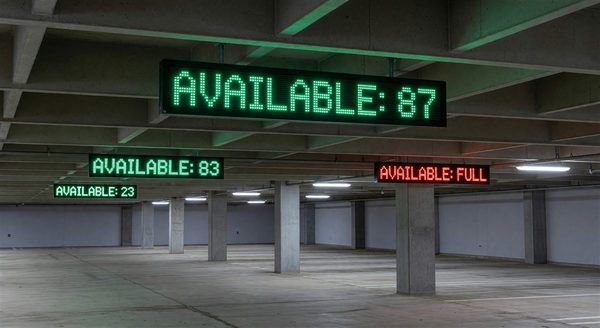
Entrance signs showing zone or level availability are the highest-visibility element of a guidance system.
Critical specifications:
- Minimum 8,000 cd/m² for locations with natural light exposure
- Automatic brightness adjustment (reduces to ~10% at night)
- Weather sealing appropriate for the installation environment (IP65 minimum for outdoor or semi-outdoor installations)
- Mean Time Between Failure (MTBF) specifications for the LED modules and power supply
Evaluation approach: Request a pilot sign installation, if possible, at the most challenging location in your facility (typically a near-entrance position with strong natural light ingress). Evaluate readability at the expected reading distance under worst-case lighting conditions.
Individual Space Indicators
Individual space LEDs mounted above each space provide the highest level of guidance — visual confirmation of space availability from the drive aisle.
Operational considerations:
- Individual space indicators roughly double the cost of a guidance system compared to entrance/zone counting only
- Failure management: individual failed indicators create visible anomalies. Plan for annual audits and batch replacement during maintenance windows
- Color convention: maintain consistency within the facility and ideally across your portfolio (red = occupied, green = available)
Management Software Review
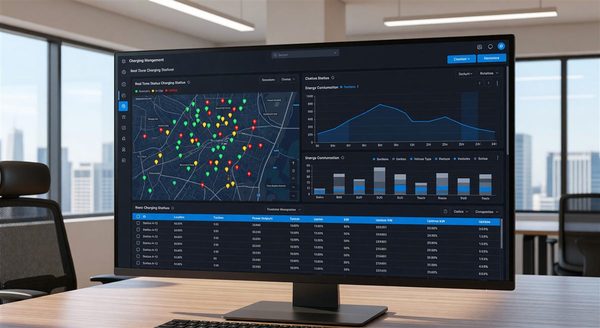
Real-Time Dashboard
The guidance management platform should provide operations staff with:
- Current occupancy by zone and level
- Individual sensor status (active, offline, fault)
- Sign status (online, offline, displaying incorrect count)
- Alert queue for anomalies requiring attention
A dashboard that requires switching between multiple screens to get a complete picture of facility status creates unnecessary cognitive load for operations staff.
Integration Points
PARCS integration: Guidance software that integrates with the PARCS transaction system can validate sensor-based counts against transaction-based counts, identifying sensor drift or orphaned transactions.
Mobile app integration: Occupancy data published to mobile apps and navigation platforms requires an API from the guidance management platform. Evaluate whether the platform supports APDS-standard data publication or has existing integrations with the aggregators you want to work with.
Dynamic pricing integration: For facilities using occupancy-based dynamic pricing, the guidance system’s occupancy data feeds the pricing engine. Evaluate the data feed API and latency for this integration.
FAQ
What is a realistic expectation for parking guidance system return on investment? ROI analysis for guidance systems typically considers: reduction in patron search time (customer experience value and associated revenue impact), reduction in staffing for directional assistance, potential revenue increase from higher utilization of previously underutilized zones, and in some analyses, reduced facility lighting costs from faster space location. Published case studies from guidance system vendors should be evaluated skeptically — independent research on guidance system ROI is available from parking industry academic literature and NPA publications.
How long does parking guidance system installation typically take for a 500-space garage? For a retrofit installation with wireless sensors: mobilization and sensor installation typically takes 2–4 weeks depending on labor resource, working around garage operations. Sign installation and cabling adds another 1–2 weeks. Software configuration, testing, and commissioning typically require an additional 2–4 weeks. Full installation for a 500-space wireless retrofit typically completes in 6–10 weeks.
What are the most common causes of poor guidance system accuracy in practice? In order of frequency: (1) Sensor calibration drift over time, particularly for ultrasonic sensors in facilities with temperature variation. (2) Vehicles that extend into adjacent sensor detection zones, causing false occupied readings. (3) Sensor mounting at incorrect height for the vehicle population (too high produces missed reads; beam angle mismatch produces cross-space reads). (4) Wireless network interference causing intermittent communication dropouts. Regular calibration audits and a systematic troubleshooting process address most of these issues.
Can a parking guidance system be expanded after initial installation? Yes — most guidance system platforms are designed for incremental expansion. Adding sections to an existing installation is generally straightforward for wired systems (extending communication loops) and somewhat more complex for wireless (adding gateways if the new area is outside existing gateway range). The management software typically scales without limitation to additional sensor counts. Confirm expansion flexibility with the specific system before initial deployment if phased expansion is likely.