What to Expect From Parking Technology at IPMI 2026
The International Parking & Mobility Institute Conference & Expo runs June 14–17 at the Baird Center in Milwaukee, and the 2026 edition arrives at a moment when several technology threads that have been building for three to four years are converging on actual deployment. This is not a show floor of concepts. Most of what will be demonstrated in Milwaukee is already running in production facilities somewhere — the question for operators attending is whether it’s ready, at what cost, and for which use cases.
This preview identifies the five technology categories most likely to dominate the expo floor and the education sessions, based on the exhibitor mix, the conference topic tracks, and what has been moving in the vendor market in the six months leading up to the conference.
1. LPR and Computer Vision: Accuracy Thresholds Are Finally Production-Grade
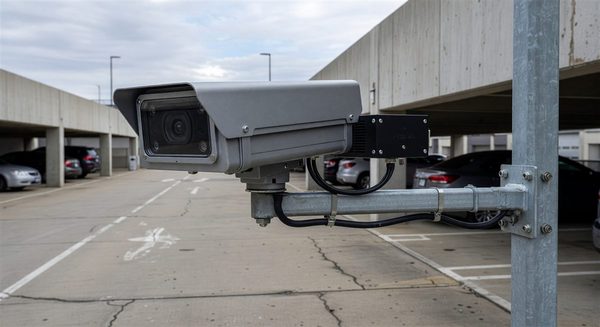
License plate recognition has been a staple of IPMI expos for more than a decade, but 2026 represents a qualitative shift in what vendors will be claiming — and, in most cases, can credibly support. The accuracy gap that historically separated high-end fixed-mount LPR from tolerable-but-noisy mobile enforcement cameras has largely closed, driven by larger training datasets, improved low-light sensor hardware, and inference optimization for edge deployment.
Expect several vendors to demo systems claiming 98–99% read accuracy across a range of plates including motorcycle, temporary, and commercial plates — the historically difficult categories. The more meaningful specification to probe is false-positive rate at those accuracy levels, which determines whether a “99% accurate” system generates acceptable erroneous enforcement events at scale.
What’s new in 2026: Computer vision applications at IPMI this year extend beyond plate reads into behavioral analytics. Metropolis — which acquired SP+ and now operates 4,200+ locations — has been deploying its checkout-free computer vision platform across airport and commercial parking facilities at scale, using a “vehicle fingerprint” model that combines plate data with vehicle visual characteristics to handle partial reads and damaged plates. Their architecture is worth examining as a case study in what production-scale computer vision deployment actually requires in terms of network infrastructure, edge compute, and data pipeline management.
The IPMI Start-Up & Innovation Pavilion will include several entrants in the AI enforcement and occupancy-detection space. Smaller vendors here tend to be building on top of commodity camera hardware with proprietary inference software — a model that keeps hardware costs low but creates integration complexity when connecting to existing PARCS back-ends.
Questions to ask at demos: What is the read rate on temporary/paper plates in your test data? What happens to revenue capture when the LPR read fails — does it fall back to ticket or manual review? What is the per-lane computational load, and does it run at the edge or require a central server?
For a deeper look at how the hardware specification translates to operational outcomes, see our earlier analysis of LPR hardware specifications and what the numbers actually mean.
2. EV Charging Integration With PARCS Systems: From Pilot to Infrastructure Decision
EV charging at parking facilities has been a conference topic for five years. At IPMI 2026, the conversation is materially different: operators who deferred EV integration decisions now face concrete infrastructure tradeoffs as EV adoption rates push charger demand past the “nice amenity” threshold in major markets.
The technical integration challenge — connecting EVSE (electric vehicle supply equipment) to PARCS revenue control and occupancy data — has several competing architectural approaches that will be represented on the expo floor:
Approach 1: Native PARCS-managed charging. Some PARCS vendors have built EVSE management directly into their platform, so a charging session is treated identically to a parking transaction — the same revenue reporting, the same permit and validation logic, the same customer account. T2 Systems, which launched a spring 2026 deployment for the Town of Canmore (Canada) integrating pay stations with their T2 Flex cloud platform, is one example of this model.
Approach 2: OCPP middleware layer. The Open Charge Point Protocol (OCPP) standard — now at version 2.0.1, with ISO 15118 “Plug and Charge” support — allows charging station data to flow to a separate charging management system that integrates with PARCS via API. This decouples the EVSE vendor from the PARCS vendor, which operators with existing PARCS investments often prefer, but introduces an integration dependency that needs maintenance as both platforms update.
Approach 3: Single-vendor ecosystem. A growing number of vendors are positioning themselves as offering both PARCS and EVSE hardware, eliminating the integration layer entirely. This simplifies initial deployment but creates vendor lock-in that is worth evaluating against the contract terms.
What to evaluate at the show: Ask any EV-PARCS integrated vendor how they handle a charging overstay — does the system charge a parking rate after the EV is charged, communicate with the driver, or simply record the session? The answer reveals how deeply the EV logic is actually integrated versus bolted on. Also ask about load management capabilities — whether the system can reduce charger output during peak electrical demand to avoid demand charge penalties, which is often the most significant operating cost for EV infrastructure.
The U.S. DOE Alternative Fuels Station Locator data and NEVI program state funding rounds through 2026 are creating tangible planning pressure for operators in states with active infrastructure spending. See also our piece on EV charging hardware in parking facilities for specification-level analysis of charger hardware types.
3. Cloud-Native PARCS Platforms: The Migration Generation
The transition from on-premise PARCS to cloud-managed platforms accelerated sharply during 2020–2022 and has continued since. At IPMI 2026, the interesting exhibit space is not vendors making the case for cloud adoption — that argument is largely settled — but rather how mature cloud platforms are differentiating on reliability architecture, multi-facility management, and API ecosystem.
Several dynamics to watch:
Uptime SLAs in practice. Cloud PARCS vendors have uniformly moved to SLA commitments of 99.9% or higher (about 8.7 hours annual downtime). The differentiation is in how each vendor handles the failure mode: does the lane go into free-flow, hold last-authorized state, or require staff intervention? Ask for the last 12-month actual uptime figure, not the SLA ceiling.
Multi-facility management depth. The IPMI education sessions include tracks on centralized parking operations, which reflects real-world consolidation among parking management companies operating dozens to hundreds of locations from a single NOC. Vendors with genuine multi-facility architectures — unified reporting, centralized permit management, cross-facility validation logic — are differentiated from single-site cloud systems that happen to be deployed at multiple locations.
API ecosystem maturity. The ability of a PARCS platform to publish and consume data via documented APIs is increasingly a procurement filter. What third-party integrations does the platform currently support? What is the rate limit structure? Is there a sandbox environment for testing integrations? These questions distinguish genuine platform plays from closed systems.
Duncan Solutions is presenting its MöbiHUB platform at booth 311 — a violation processing and mobility operations system that illustrates the convergence of traditional parking enforcement software with broader mobility data management.
For an evaluation framework applicable to any cloud PARCS vendor on the show floor, see our PARCS software evaluation guide.
4. Contactless and Mobile-First Payment Hardware: The Terminal Upgrade Cycle
EMV contactless payment terminals had already reached high penetration in parking pay stations before 2024. What has changed heading into IPMI 2026 is the maturity of unattended payment hardware at the component level and the consolidation of software certifications that made deployment friction-heavy.
ID TECH, which is exhibiting at the conference, produces payment readers specifically optimized for unattended parking environments. Their VP6825 is PCI P2PE validated and outdoor-rated at Level 6 EMV P2PE, supporting Apple Pay, Google Pay, EMV chip, magstripe, and QR in a single unit. The significance of PCI P2PE validation for parking operators is scope reduction: a properly deployed P2PE solution removes the payment terminal hardware from the full PCI-DSS assessment scope, which meaningfully reduces annual audit complexity for operators running many lanes.
Mobile-first payment: PayByPhone continues expanding its network of parking locations where payment is initiated and completed entirely via mobile app, with no physical terminal interaction required. The architectural implication for operators is that mobile-first entry points require LPR integration for enforcement — the system needs to match a plate to an active session — which returns us to the accuracy discussion in category 1.
QR code ticketing resurgence: Several vendors are bringing renewed attention to QR-based entry/exit, particularly for facilities that want to reduce gate hardware costs while maintaining physical access control. A QR printed at a kiosk entry or sent to a phone can carry the session data needed for exit validation. The tradeoff is user behavior reliability — QR-based workflows require the driver to complete a discrete action that contactless tap or LPR-entry eliminates.
The hardware refresh question: Many facilities installed their current pay station hardware in 2016–2019. The combination of EMV liability shift compliance, contactless card adoption rates now exceeding 60% of card-present transactions in the U.S. (per Visa contactless payment data), and approaching end-of-support cycles for older terminals makes this a natural window for hardware refresh evaluation. Expect vendors to have updated TCO models that reflect the current interest rate environment.
5. AI and ML Applications: What’s Actually in Production
The phrase “AI-powered” now appears in approximately 80% of parking technology marketing materials, which means the signal-to-noise ratio at IPMI 2026 will be low. A useful framework for evaluating AI claims on the expo floor:
Inference vs. prediction: Most deployed “AI” in parking today is inference — a model trained on historical data classifying current inputs (is this a license plate? is this space occupied?). This is genuinely useful and should be evaluated on accuracy and latency metrics. “AI” that generates predictions — demand forecasting, dynamic pricing, maintenance scheduling — is a different category with different evaluation criteria: how far in advance, with what accuracy, trained on how much data, and what happens when the model is wrong.
Dynamic pricing maturity: Several PARCS platforms now offer rate-setting algorithms that adjust parking rates based on occupancy, time of day, and event calendars. This is among the most commercially mature ML applications in the sector. The evaluation question is how the system handles edge cases — a full facility during an unexpected event, a sensor failure that underreports occupancy — and whether operators can override or constrain the algorithm’s output range.
Demand forecasting for EV charging: A small number of vendors are beginning to apply ML-based demand forecasting to EV charger management — predicting charger load by hour of day and day of week to pre-position capacity and schedule managed charging windows. This is an early-stage application worth tracking but not yet production-ready at most facilities.
Predictive maintenance: Gate operators, ticket dispensers, and payment terminals all have failure signatures that can be detected in sensor data before a component fails. The IPMI education sessions include tracks on operational efficiency that will likely touch predictive maintenance frameworks. Vendors offering this capability should be able to provide case study data on mean time between failures before and after predictive maintenance implementation.
The AI enforcement platforms in the Start-Up Pavilion are worth a close look specifically for their data transparency posture — whether they can explain how a specific enforcement decision was made, what appeal mechanisms exist, and how they handle edge cases involving protected characteristics under state biometric data laws. See our analysis of AI parking enforcement systems and their civil liberties implications.
How to Use the Expo Floor Efficiently
IPMI runs 200+ exhibitors across four days. A few structural observations for technology buyers:
Tier by decision horizon. Separate vendors into three buckets: (1) categories where you have an active RFP or budget in the next 12 months — spend full demo time here; (2) categories on a 2–3 year horizon — get one technical conversation and collect documentation; (3) everything else — collect a card and move on. The expo floor rewards focus.
Bring your integration map. Any vendor worth serious evaluation should be able to show you how their system connects to your existing PARCS, LPR, access control, and payment processor. If they can’t answer integration questions without a follow-up call, that’s diagnostic information.
Use the Start-Up Pavilion for competitive intelligence, not procurement. The innovation-stage companies presenting there are pre-production or early-production. Their value to an operator attending IPMI is understanding where the technology frontier is moving, not replacing your gate hardware next quarter.
The education sessions are underused. The technology tracks at IPMI 2026 include sessions on AI integration, EV infrastructure, data analytics, and curbside management — formats where operators share real deployment experience rather than vendor marketing. Attendance at two or three relevant sessions often produces more actionable information than two hours on the expo floor.
Frequently Asked Questions
What technology categories are most represented at IPMI 2026?
Based on the exhibitor mix and conference topic tracks, the dominant categories at IPMI 2026 are license plate recognition and computer vision, EV charging integration, cloud PARCS platforms, contactless payment hardware, and AI-driven analytics. Curbside management and micromobility infrastructure are also well represented in the mobility operator segment.
What should parking operators prioritize when evaluating LPR systems at the conference?
Look past headline accuracy claims and ask for false-positive rates, read accuracy on temporary and motorcycle plates, and failure mode behavior — what the system does when it can’t read a plate. Also clarify whether the system processes on-device (edge) or requires a central server, as this has material implications for network infrastructure costs and latency.
How mature is EV charging integration with PARCS systems in 2026?
The integration is deployable but still varies significantly by vendor. OCPP 2.0.1 is the dominant interoperability standard and supports ISO 15118 Plug and Charge. The evaluation question is not whether integration is possible but whether the combined system handles overstay enforcement, load management, and revenue reporting as a unified workflow rather than two separate systems sharing data via API.
Are cloud PARCS platforms reliable enough for critical parking infrastructure?
Yes, for most facilities. The meaningful question in 2026 is not cloud viability but specific architecture: how a given platform behaves during connectivity loss, what the contractual SLA is versus actual historical uptime, and how the platform handles failure at the lane level. Vendors with production deployments of more than 500 lanes should be able to provide real uptime data.
What AI applications in parking are actually production-ready today?
Computer vision occupancy detection and LPR inference are production-ready at commercial accuracy levels. Dynamic pricing algorithms are mature in platforms with sufficient historical occupancy data. Demand forecasting for EV charging and predictive maintenance for gate hardware are in early production. Fully autonomous enforcement with no human review step is not yet mainstream and carries significant legal risk in jurisdictions with biometric data laws.