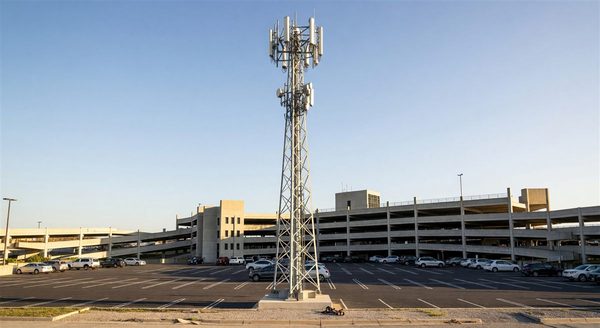
Network Infrastructure Design for Parking Garages and Surface Lots
Modern parking facilities are network-dependent systems. LPR cameras, occupancy sensors, pay stations, access control readers, EV chargers, intercom systems, and management workstations all require network connectivity. A parking facility’s network infrastructure — structured cabling, switching, wireless access points, and fiber backbones — is the foundation layer that all parking technology depends on.
Parking facilities present network infrastructure challenges that differ from typical commercial office buildings: extended cable runs in concrete structures, RF interference in dense parking environments, exposure to temperature extremes and vehicular exhaust, and the need for high availability in 24/7 operational environments.
Structured Cabling Standards and Parking Environments
TIA-568 (the ANSI/TIA structured cabling standard) defines cable categories, connectors, and performance specifications. For parking facilities, the applicable tier is TIA-568-C.2 for copper cabling (Cat 5e minimum, Cat 6A recommended for new installations).
Cat 6A advantages in parking applications:
- 10 Gbps support for uplink segments and high-bandwidth camera applications
- Better performance margins for long runs (up to 100m per TIA-568, but parking facilities sometimes push toward this limit)
- Improved noise immunity in environments with electrical interference from motors, HVAC, and lighting
Cable routing and protection: In parking structures, cable must be routed in conduit or cable tray that protects against physical damage from vehicles, moisture, and exposure. Minimum conduit sizing per NEC Article 358 (EMT) or Article 356 (LFMC for flexible sections) applies.
Plenum-rated cable (CMP) is required in air handling spaces; in most parking structures with open deck design, this is not the primary rating concern. Direct burial cable is required for surface lot runs in conduit or directly buried.
PoE Power Architecture
Power over Ethernet (IEEE 802.3) enables remote devices to receive power through the data cable, eliminating separate AC power runs to each device location. In parking facilities, PoE dramatically reduces installation cost for cameras, access control readers, intercom stations, and wireless access points.
PoE Standards:
- PoE (802.3af): 15.4W maximum at switch port, 12.95W at device — sufficient for basic cameras and access control readers
- PoE+ (802.3at): 30W at switch port, 25.5W at device — covers most parking cameras, intercoms, and mid-power access points
- PoE++ (802.3bt) Type 3: 60W at switch port — supports high-performance access points, cameras with heaters, and some EV charging management devices
- PoE++ (802.3bt) Type 4: 90W — industrial and specialty devices
For a parking facility network design, the PoE budget of each switch determines how many devices it can power simultaneously. A 24-port PoE+ switch with a 370W PoE budget supports 24 devices at 15.4W each — check that the actual device power draw across all ports doesn’t exceed the switch’s total PoE budget.
Wireless Coverage in Parking Structures
WiFi coverage in parking structures is notoriously challenging. Concrete columns, vehicle bodies, and the dense RF environment created by hundreds of metal vehicles absorb and reflect 2.4 GHz and 5 GHz signals in unpredictable ways.
Access point placement strategy for parking garages:
Standard overhead AP placement (ceiling-mounted at 20–25 foot spacing, appropriate for open office environments) does not translate directly to parking garages. The concrete ceiling and vehicle obstruction require lower mounting heights and higher AP density in practice.
Directional antennas aimed along rows of parking spaces outperform omnidirectional antennas in long narrow aisles. Some operators use a hybrid approach: directional antennas for coverage along drive aisles, omnidirectional for open areas near ramps and entries.
WiFi 6 (802.11ax) for parking applications:
WiFi 6’s OFDMA (Orthogonal Frequency Division Multiple Access) handles high-device-density environments better than previous WiFi generations — parking facilities with large numbers of IoT devices (sensors, cameras, EV chargers) benefit from WiFi 6’s improved efficiency under device load. Target signal strength of -67 dBm or better at the device location ensures reliable operation for critical parking systems.
Fiber Backbone Considerations
Long-haul segments in parking facilities — from the entrance equipment room to exit lanes, from the main MDF to IDFs on each level of a multi-level structure — benefit from fiber rather than copper due to:
- Distance: Fiber supports distances far beyond the 100m limit of copper TIA-568 specifications, relevant in large surface lots
- Noise immunity: Fiber is immune to electrical interference from motors, generators, and other industrial equipment present in parking environments
- Bandwidth: Single-mode fiber supports future bandwidth upgrades without cable replacement
OS2 single-mode vs. OM3/OM4 multimode: For new parking facility installations, OS2 single-mode fiber is the recommended backbone specification. The distance and bandwidth advantages over multimode outweigh the slightly higher transceiver cost, and OS2 is forward-compatible with any future bandwidth upgrades. Multimode is appropriate where runs are short and cost optimization is prioritized.
Environmental Hardening
Network equipment in parking facilities faces environmental stresses that office-grade equipment is not rated for.
Temperature range: Equipment rooms in parking structures may reach 50°C+ in summer without HVAC. Switches and other active equipment should be rated for the expected ambient temperature range. Industrial-grade switches rated to 70°C operating temperature provide necessary margin.
Humidity and condensation: Transitions between heated and unheated spaces in winter create condensation risk. IP-rated enclosures (IP54 minimum) for equipment in exposure-prone locations protect against moisture ingress.
Vibration: In multi-level parking structures, vibration from vehicle traffic affects equipment and cable connections over time. Secure cable terminations and vibration-resistant equipment mounting reduce failures from this source.
Power quality: Parking facilities — particularly those with large HVAC systems, elevators, and EV chargers — can have poor power quality (voltage sags, surges, harmonics). UPS systems with appropriate capacity protect network equipment and parking control systems from power anomalies.
FAQ
What network bandwidth should be planned per LPR camera? LPR cameras vary significantly in bandwidth consumption depending on whether onboard or server-side OCR is used, video resolution, and frame rate. Onboard OCR cameras sending only plate read data require minimal bandwidth (<1 Mbps). Cameras sending full video streams for server-side processing may require 4–8 Mbps per camera at 1080p/15fps. Plan for 2x peak bandwidth headroom on camera segments.
How should parking facility networks be segmented? Network segmentation separates parking operational technology (OT) — access control, payment systems — from general IT traffic. A minimum of separate VLANs for OT devices and IT devices is recommended; physical separation (separate switches) provides stronger isolation for high-security or PCI DSS scope reduction purposes. PARCS system networks touching cardholder data should be isolated to minimize PCI DSS compliance scope.
What redundancy is appropriate for parking facility network infrastructure? Critical parking entry and exit equipment should have redundant network paths — dual fiber runs from the main equipment room to entry/exit points, connected to separate switches. Redundant power paths (two UPS systems feeding different circuit breakers) prevent single-point power failures. The appropriate redundancy level scales with the revenue impact of an outage: a 500-space revenue parking facility warrants higher redundancy investment than a 50-space employee lot.
Are cellular-connected parking devices a viable alternative to wired network infrastructure? For isolated devices in locations where running cable is impractical or cost-prohibitive — a revenue pay station on a remote surface lot, for example — cellular connectivity (4G LTE, 5G) is a viable solution. Cellular-connected devices carry ongoing data plan costs and introduce latency variability, but modern parking management platforms handle intermittent connectivity gracefully. Avoid cellular as the primary connectivity for high-density installations where per-device data costs compound quickly.