HUB Parking Technology announced a redesigned Access Reader on July 29, 2026. Taken on its own, a lane device refresh is unremarkable. Read against what the previous generation of this class of hardware assumed, the specification is a reasonably precise statement about where the category is going — and it is worth reading that way rather than as a product announcement.
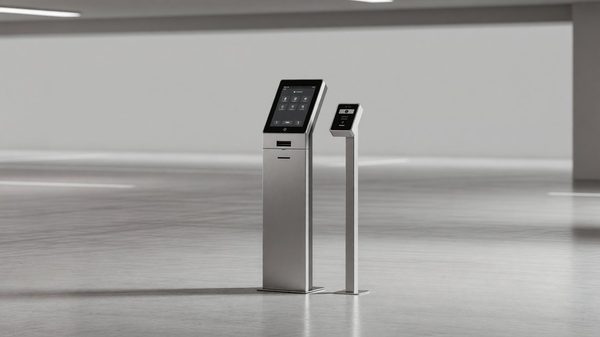
The device is positioned within the vendor’s Jupiter ecosystem, with a 7-inch touch screen, an aluminum housing and tempered glass front panel, a new-generation scanner, an integrated intercom, and a front-opening architecture for field maintenance. Credentials supported include tickets, QR codes, proximity cards, Bluetooth credentials, mobile app credentials, and license plates. It is offered as a ready-to-install package with mounting accessories, and it is stated to work across ticketed, hybrid, ticketless, and gateless models.
Four things in that list are worth separating from the marketing.
The credential list is a transition artifact, not a feature
A device that reads tickets, QR codes, proximity cards, Bluetooth, a mobile app, and plates is not a device designed for a facility that uses all six. It is a device designed for a facility that is moving from some of them to others and cannot cut over on a single date.
This is the practical reality of PARCS modernization and it is why “digital-first” hardware still ships with a ticket path. Monthly parkers on proximity cards do not migrate to mobile credentials on a schedule the operator controls. Transient visitors arrive with whatever they have. A university or hospital campus typically runs three populations at once, indefinitely.
The buying implication is specific: evaluate the credential list by what it lets you retire, not by how long it is. A reader that supports six credential types has value only if adopting it removes a separate piece of lane hardware — a standalone card reader, a separate QR scanner, an intercom post. If it adds a seventh device to a lane that still has all six, the integration count went up, not down.
Front-opening maintenance is the line item that shows up in the operating budget
The redesign’s front-opening system for simplified field maintenance is the kind of specification that reads as trivial and is not.
Lane device servicing cost is driven substantially by access. A unit that requires rear or side clearance to open dictates how it can be sited, and in retrofit installations that constraint frequently means the device cannot go where the lane geometry wants it. More routinely, it means a technician needs to work in a live traffic lane from a position that requires the lane to be closed.
Serviceability specifications rarely appear in evaluation matrices, which are usually built around throughput and credential support. They belong there, because mean time to repair is a function of physical access at least as much as parts availability — and lane closure during service has a measurable revenue cost that a purchase-price comparison does not capture.
Integrated intercom reflects the staffing model, not the technology
The intercom is described as enabling unattended operation through remote assistance. That is the actual subject of this redesign, and of most current lane hardware development.
The hardware is not being built for facilities with a booth attendant. It is being built for facilities where the attendant is centralized, remote, possibly covering multiple sites, and reached through the device rather than in person. Once that is the operating model, the intercom stops being an accessory and becomes the failure-critical component — because when a credential does not read, the intercom is the entire recovery path.
Two questions follow for any buyer evaluating this class of device. What happens to the intercom when network connectivity is lost, given that connectivity loss and credential failure are correlated events? And what is the audio performance in a real lane, with engine noise, weather, and a driver who does not lower the window fully? Vendor specifications do not answer either. Site references from facilities with similar acoustics do.
Materials selection tracks a real failure population
Aluminum housing with a tempered glass front is a durability choice aimed at the two things that destroy lane devices: weather and contact.
The glass front matters more than it appears to. A 7-inch touch screen in an outdoor lane is exposed to direct sun, freeze-thaw, cleaning chemicals, and abrasion from ice scrapers and gloves. Touch screens in this environment fail through surface degradation and readability loss well before the electronics do, and a device whose primary interface is a screen has made screen longevity a lifecycle question rather than a cosmetic one.
For northern installations, the question to put to any vendor is not the operating temperature range on the datasheet but the touch-response behavior at the bottom of that range, with a gloved hand. This is a routine gap between specification and field performance.
What to take from a single vendor announcement
Read across the category rather than at one product, the direction is consistent: consolidation of credential reading into fewer lane devices, screens replacing fixed-function buttons and slots, intercom promoted from option to core, and serviceability treated as a design constraint. That direction is driven by the shift to remote and centralized staffing far more than by any advance in reading technology.
None of that argues for or against this particular device, and a vendor’s own announcement is not evidence of field performance. The useful exercise is to take the specification as a checklist and apply it to whatever is actually being evaluated: what does adopting this let us remove, how is it serviced without closing the lane, what happens when the network drops, and how does the interface behave in February.
Those four questions will separate comparable products from each other more reliably than any credential-support table.