Spec Bulletin 245 requires that EMV-compliant contactless terminals be able to decode IQ modulation. It is a Level 1 requirement — the physical and radio-frequency layer, not the application layer — and it has been folded into the EMV Contactless Interface Specification since Version 3.1 in December 2020. For parking, where a pay station or lane reader routinely stays in service for eight to twelve years, a 2020 Level 1 change is squarely a 2026 problem.
What IQ modulation is, without the maths
When a card or phone answers a reader, it does so by modulating the reader’s own carrier field. A passive plastic card produces a fairly simple response. The signal a terminal receives generally contains both in-phase (I) and quadrature (Q) components; a terminal that only demodulates one component is reading part of the picture.
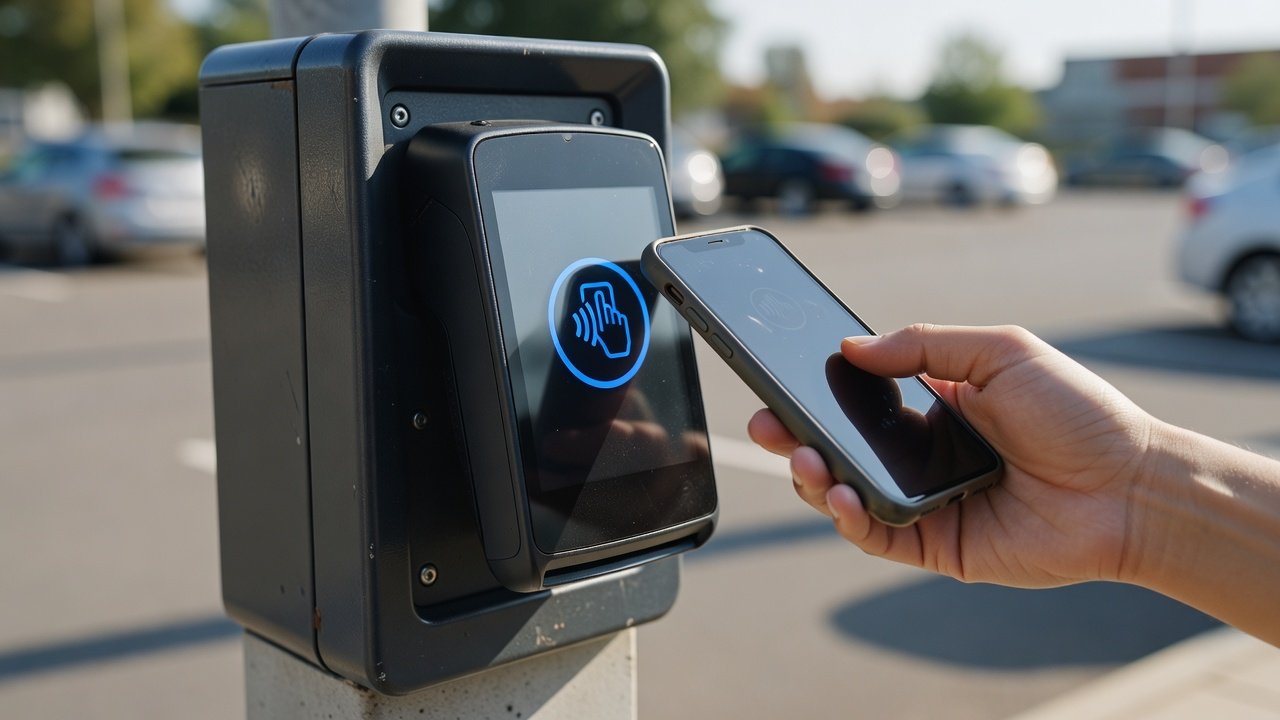
The reason this became a specification requirement is the growing variety of payment devices. Phones, watches, rings, and embedded vehicle secure elements are active devices with their own power and their own radio behaviour. Their responses are more dynamic than a card’s, and the phase relationship between the response and the carrier is not guaranteed to be convenient. A terminal capable of IQ demodulation can decode that dynamic format, which yields faster transactions and more tolerance for where the device is physically held relative to the antenna.
That last point is the one parking operators feel. Positional tolerance is the difference between a tap that works from the driver’s seat and a tap that requires the driver to open the door and lean out.
Who this actually affects
If your contactless readers were certified against EMV Contactless Level 1 v3.1 or later, you are covered — the requirement is integrated into that specification and every subsequent version. The exposure sits with terminals certified against earlier versions and still in the field.
In parking, that population is larger than in most retail verticals for three structural reasons. Unattended terminals are capital assets depreciated over long schedules. Lane hardware is expensive to replace because the cost is dominated by civils and downtime rather than the reader itself. And parking rarely experiences the retail refresh trigger of a POS software end-of-life forcing a hardware decision.
The practical symptom of a non-compliant reader is not a hard failure. It is an elevated rate of retries and partial reads, concentrated in phone and wearable taps rather than plastic cards, and it will be worst on the devices with the most dynamic responses. Because it degrades rather than breaks, it tends to be logged as “customer error” or absorbed into general intercom volume rather than recognised as a hardware limitation.
How to find out where you stand
Start with the EMVCo Level 1 certification record for each reader model in your estate — your vendor or integrator holds these, and the record states which version of the Contactless Interface Specification the device was approved against. Model name alone is not sufficient, because manufacturers ship hardware revisions under the same commercial name.
Then look at your own data. Pull tap-retry and read-failure rates by lane and by device type if your PARCS distinguishes them. A lane running materially above its peers on contactless retries, with card transactions behaving normally, is a candidate. So is a lane where intercom calls cluster around payment rather than around tickets or barriers.
Finally, test physically. Hold a phone at the distances and angles a driver would actually use — arm extended from a seat belt, at the edge of the antenna field — rather than pressed flat against the target. Positional tolerance is precisely what IQ demodulation improves, so it is where a deficient reader shows itself.
Planning the refresh
Few operators will replace readers for this reason alone, and few should. The sensible approach is to fold the Level 1 version check into decisions already on the calendar.
A PCI PTS approval expiry is the natural pairing: if a device is being replaced for payment-security reasons, specify the Level 1 version in the requirement rather than assuming it. So is any lane rebuild, any PARCS platform migration, and any move to a validated P2PE solution, since those projects already involve touching the reader.
When specifying replacements, write the version into the procurement document explicitly — “EMV Contactless Level 1 v3.1 or later” — rather than accepting “EMV certified,” which is true of every reader ever approved and tells you nothing about which bulletins it incorporates.
The takeaway
This is not a deadline-driven compliance event with a penalty attached. It is a slow degradation in the tap experience for exactly the customers most likely to be paying by phone, on hardware that is otherwise still working. That makes it easy to ignore and cheap to fix if it is folded into refresh cycles already funded. Audit the Level 1 version across your estate now, so that when a lane comes up for replacement the specification is already written.