IoT-Connected Parking Infrastructure: Sensors, Protocols, and Edge Computing
The Internet of Things has enabled a wave of parking facility instrumentation that was economically impractical a decade ago. Wireless occupancy sensors, connected pay stations, EV charger management systems, environmental monitors, and predictive maintenance platforms all depend on IoT connectivity to move data from physical parking infrastructure to management systems.
This article examines the IoT technology architecture relevant to parking — the sensor types, wireless protocols, edge computing approaches, and data management patterns that define how connected parking infrastructure operates.
Sensor Categories in Connected Parking
Occupancy and Space Monitoring
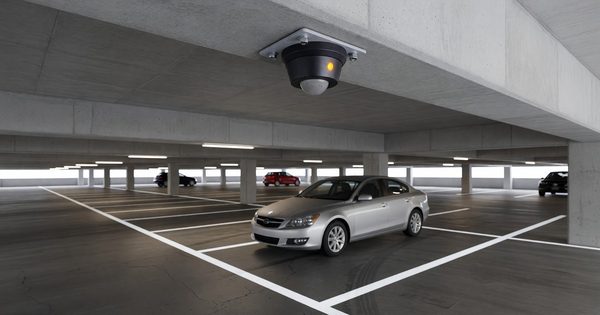
Per-space occupancy sensors (ultrasonic, magnetic, and computer vision) are the most densely deployed sensor type in smart parking. In a 1,000-space facility, deploying individual sensors means managing 1,000 connected endpoints — more than most enterprise IT environments — across the physical space of the facility.
Wireless sensor protocols for occupancy applications must balance:
- Power efficiency: Battery-powered sensors that last 3–7 years without replacement
- Range: Reliable connectivity from sensor to gateway across concrete structures
- Scalability: Support for hundreds of sensors per gateway
- Data latency: Occupancy state changes must reach the management system within 60–120 seconds for guidance system utility
Environmental Sensors
Environmental monitoring sensors in parking garages measure CO/CO₂ levels (for ventilation control), temperature and humidity (for equipment protection), and air quality. Some facilities also monitor noise levels and lighting levels to support both safety and compliance reporting.
Environmental sensors typically have lower frequency data requirements (readings every 5–15 minutes is adequate for most applications) and can use lower-power protocols than occupancy sensors.
Equipment Monitoring Sensors
Pay stations, gate operators, elevators, and EV chargers generate operating state data that supports predictive maintenance — temperature, vibration, door open/close events, power draw anomalies, and component health indicators. This data requires near-real-time transmission for fault alerting but is manageable volume per device.
IoT Communication Protocols
LoRaWAN
LoRaWAN (Long Range Wide Area Network) operates on unlicensed sub-GHz spectrum (915 MHz in North America) and provides:
- Range: 2–15 km line-of-sight (1–3 km in urban/indoor environments)
- Power efficiency: End-device battery life of 5–10 years at typical sensor polling rates
- Data rate: Low (250 bps to 50 kbps), appropriate for small sensor payloads
- Infrastructure: Requires LoRaWAN gateways connected to a network server
LoRaWAN is well-suited for geographically distributed parking applications — surface lots, on-street meters, and remote parking facilities where cellular coverage is inconsistent and WiFi infrastructure is absent. In structured parking with existing network infrastructure, LoRaWAN may offer range advantages over competing protocols with lower infrastructure overhead.
The LoRa Alliance maintains the LoRaWAN specification and certification program. Device interoperability across vendors is verified through the certification process.
Zigbee and Mesh Networks
Zigbee (IEEE 802.15.4-based) forms self-healing mesh networks where devices relay messages through neighboring devices. This is advantageous in parking structures where direct sensor-to-gateway paths may be blocked by concrete and steel.
Zigbee’s key advantage is mesh self-healing: adding or removing devices from the network does not require reconfiguration. The network automatically adapts routes. The limitation is range — each mesh hop covers 10–75 meters indoors, limiting the number of hops practical for large facilities.
Zigbee is widely deployed in parking occupancy sensor networks in structured garages.
NB-IoT and LTE-M
Narrowband IoT (NB-IoT) and LTE-M (LTE Category-M1) are 3GPP cellular standards designed for IoT device connectivity. They operate on licensed cellular spectrum, leveraging carrier network infrastructure rather than facility-deployed gateways.
Advantages:
- No facility gateway infrastructure required
- Cellular coverage where it exists
- QoS guarantees on licensed spectrum
- Device management through carrier infrastructure
Limitations:
- Monthly data plan costs per device
- Coverage depends on carrier network (may be poor in underground garages)
- Higher cost per device than non-cellular protocols
NB-IoT and LTE-M are most practical for dispersed outdoor parking (surface lots, street meters) where cellular coverage is reliable and per-device costs are justified by infrastructure savings.
MQTT: The Message Layer
MQTT (Message Queuing Telemetry Transport, ISO/IEC 20922) is the dominant application-layer protocol for IoT sensor data in parking and building automation contexts. MQTT’s publish/subscribe architecture:
- Sensors publish state changes to a topic (e.g.,
parking/facility/level2/space047/occupancy) - Management systems and analytics platforms subscribe to relevant topics and receive data as it arrives
- A broker (MQTT server) manages topic subscriptions and message routing
MQTT is lightweight (minimal protocol overhead), supports quality of service levels (QoS 0: at most once, QoS 1: at least once, QoS 2: exactly once), and is well-supported in IoT device firmware across all major IoT chip vendors.
Edge Computing in Parking IoT
Edge computing moves data processing closer to the source, reducing latency and network bandwidth requirements. In parking applications, edge computing serves several functions:
Local Decision Making
For time-sensitive parking operations — gate control, space guidance updates, payment processing — processing decisions at the edge (in the facility’s on-premise hardware) rather than in a remote cloud reduces the dependency on internet connectivity and cloud platform availability.
A PARCS lane controller that makes access decisions locally, using a synchronized permit and payment database, continues operating correctly when internet connectivity is interrupted. Cloud-dependent architectures that cannot operate offline are inappropriate for revenue-critical parking operations.
Data Aggregation and Filtering
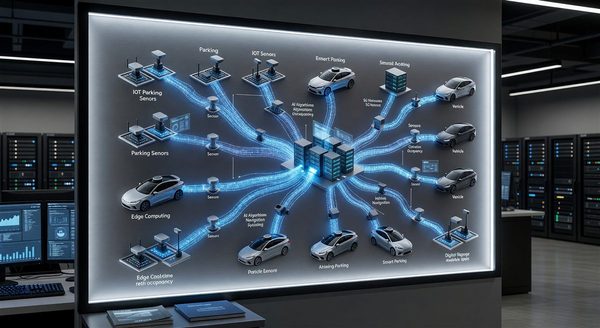
A parking facility with 1,000 occupancy sensors changing state continuously generates a high-volume data stream. Edge aggregation — accumulating state changes and publishing summarized counts (e.g., zone occupancy every 30 seconds) rather than individual sensor events — reduces cloud bandwidth and processing costs.
Edge Analytics
Video analytics for LPR, occupancy detection, and anomaly detection increasingly run on edge-compute-enabled cameras rather than on central servers. This reduces video bandwidth (processed results are transmitted rather than raw video), improves privacy (images may be processed and discarded at the edge), and reduces cloud processing costs.
Platform Architecture for Connected Parking
IoT Platform Integration Options
Parking IoT data flows to management systems through several architectural paths:
Native platform integration: PARCS and parking management platforms that natively consume IoT sensor data through integrated protocols. Simplest for the operator; limits to the vendor’s supported device types.
Third-party IoT platforms: Platforms like AWS IoT Core, Azure IoT Hub, or Google Cloud IoT aggregate sensor data from multiple device types and protocols, providing a data pipeline to analytics tools and operational systems. More flexible; requires integration engineering.
Open-source infrastructure: MQTT brokers (Eclipse Mosquitto, HiveMQ), open-source IoT platforms (OpenHAB, Home Assistant adapted for commercial use), and custom integration scripts. Maximum flexibility at maximum operational complexity.
FAQ
What is the realistic battery life of wireless parking occupancy sensors? Battery life varies significantly by transmission frequency, message size, protocol, and temperature. Typical wireless parking occupancy sensors (ultrasonic or magnetic, LoRaWAN or Zigbee) achieve 3–7 years of battery life in real-world deployments. Temperature extremes (cold climates, hot surface installations) reduce battery life. Plan for battery replacement intervals and include the labor cost in total cost of ownership calculations.
How should parking operators approach IoT security for sensor networks? IoT sensor networks present distinct security challenges: large numbers of devices, limited firmware update capabilities, and physical accessibility. Key controls: segregate sensor networks on dedicated VLANs with no direct internet access; use encrypted communication (TLS/DTLS for MQTT); change default device credentials before deployment; maintain a device firmware update process; and monitor for anomalous traffic patterns that may indicate compromise.
What data volumes should parking operators expect from IoT sensor deployments? A 500-space facility with per-space occupancy sensors, each transmitting state changes 10–20 times per day, generates roughly 5,000–10,000 messages per day at payloads of 50–200 bytes per message — under 2 MB/day raw. After aggregation and compression, IoT data volumes for most parking facilities are modest and do not constrain platform or storage selection. Video analytics data volumes are substantially higher.
Is there a standard IoT platform recommended for parking facility deployments? No single IoT platform has emerged as a parking industry standard. AWS IoT Core, Azure IoT Hub, and on-premise MQTT brokers are all in production use. Platform selection should be driven by the operator’s existing cloud infrastructure relationships, the IoT platforms supported by key parking vendors, and the in-house technical capability to manage the platform. Avoid bespoke IoT platform builds when commercial alternatives address the requirements.