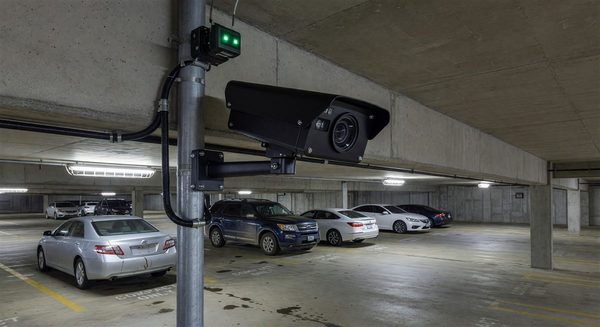
The modern parking camera is no longer just a sensor. In 2026, the best-deployed units carry neural processing hardware capable of running inference workloads that would have required a rack server five years ago. The result is an architectural split that every parking technology buyer and operator needs to understand: some intelligence lives at the camera, and some lives in the cloud — and the boundary between them is not obvious from a datasheet.
For anyone evaluating an LPR parking system, the on-camera versus cloud question has direct consequences for latency, network cost, data sovereignty, and the kinds of analytics your software layer can realistically deliver. This article maps that boundary in precise technical terms, covers the hardware making it possible, and explains when keeping workloads in the cloud is still the right call.
Edge vs. Cloud: What the Distinction Actually Means
“Edge AI” means model inference runs on a processor co-located with the sensor — in this context, inside the camera housing or in a small compute unit bolted immediately next to it in the lane. The camera captures raw pixels, a neural network processes those pixels, and a structured result (a plate string, a vehicle class, an occupancy count) exits the device rather than raw video.
“Cloud AI” means the camera streams video or compressed frames to a remote server — either on-premises rack hardware or a public cloud endpoint — where inference runs centrally. Results flow back to the access control system or parking management software over the network.
The distinction matters because every hop adds latency and cost. A cloud-dependent plate read requires: encode frame, transmit over LAN or WAN, queue for GPU, run inference, return result. An edge-native plate read requires: capture frame, run inference on local NPU, output result string. Under normal LAN conditions the difference is 50–300 ms. In a PARCS gate lane where the barrier must lift before a driver stops, 200 ms of unnecessary latency is the difference between a smooth experience and a queue.
There is also a data minimization argument. Under several state privacy statutes and the general direction of GDPR enforcement, transmitting identifiable vehicle imagery to a cloud endpoint creates retention and consent obligations that never arise if the plate string leaves the camera and the image is discarded on-device.
What Current Parking Cameras Can Run On-Device
Contemporary smart cameras from vendors like Axis and Hikvision ship with application programming environments (Axis ACAP, Hikvision open platform) that allow third-party inference models to run as on-camera apps. The workloads that fit within current device envelopes — typically 1–4 TOPS of neural processing alongside 1–2 W thermal limits — fall into a defined set:
- License plate detection and OCR — the primary read-and-compare pipeline, including character segmentation
- Vehicle presence detection — loop emulation and trigger logic without physical inductive loops
- Coarse vehicle classification — sedan, SUV, motorcycle, truck (4–6 class models run comfortably within 2 TOPS)
- Occupancy binary — stall occupied / stall empty at the camera level in covered garages
- Tamper and obstruction alerts — lens block, spray, repositioning
What does not fit cleanly on current production-grade cameras: large multi-class attribute models (color + make + model simultaneously), behavioral trajectory analysis over extended time horizons, and cross-camera matching at scale. Those workloads still require a server tier.
Plate Reads Happen at the Edge — Why That Matters for Latency
License plate recognition is the canonical edge AI workload in parking, and the latency case for on-device inference is unambiguous. A gate lane operating at normal entry speeds (3–8 mph approach) gives the system roughly 800–1,200 ms to detect, read, validate, and actuate before the vehicle is at a full stop. A purely cloud-dependent pipeline consumes 300–600 ms of that budget on network round-trip and queue time alone, leaving minimal margin for read retries on difficult plates (rain, glare, dirty frames, partial occlusion).
Edge-native LPR pipelines typically complete the full detect-OCR-validate cycle in 80–150 ms end-to-end on modern embedded NPUs. That reclaimed latency budget allows multiple read attempts per vehicle approach — critical for accuracy on plates that require image preprocessing (contrast normalization, perspective correction) before character recognition performs reliably.
NIST’s License Plate Recognition guidance (available via nist.gov) documents accuracy variance across illumination and motion conditions; the guidance consistently shows that frame selection quality — which improves with faster local processing cycles — is among the most significant accuracy levers available to system integrators.
For an LPR parking system serving high-throughput lanes (airports, event venues, dense urban garages), the case for running plate inference at the camera is now operationally settled. The open question is which secondary workloads accompany it.
Vehicle Classification, Occupancy, and Anomaly Detection at the Edge
Beyond plate reads, three secondary inference workloads are increasingly deployed on-camera.
Vehicle classification matters for rate differentiation (motorcycles often pay different rates than passenger cars) and for fleet versus transient separation in mixed-use facilities. Coarse 6-class models — passenger, SUV/crossover, pickup, van, motorcycle, commercial — run at 15–30 fps on mid-tier embedded platforms. Fine-grained make/model recognition (30+ classes) currently pushes thermal limits on most production cameras; these workloads are better handled by a local server node receiving thumbnails rather than raw video streams.
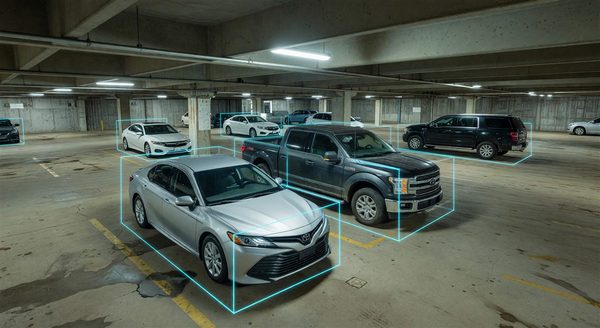
Stall-level occupancy via overhead cameras is now a mature edge deployment. Single-camera units covering 8–12 stalls run binary occupied/empty classification per stall at high accuracy without any cloud dependency. The on-device result is a stall state vector that the parking management software layer polls via API. Vendors including Hikvision ship specific overhead occupancy camera SKUs with inference baked in. This architecture means a 500-stall garage can publish real-time occupancy with no video leaving the premises — a meaningful privacy and bandwidth win.
Anomaly detection — wrong-way vehicle entry, tailgating, loitering — is the edge workload with the most uneven maturity across vendors. Tailgate detection specifically requires multi-frame temporal reasoning, which is memory-intensive. Current implementations typically use lightweight two-frame differencing and proximity heuristics rather than full trajectory models; they are useful as soft alerts but should not be treated as authoritative without human review. More capable behavioral analysis remains a cloud or local-server workload for now.
For deeper context on what computer vision in parking can deliver beyond basic LPR, see our coverage of computer vision applications extending beyond plate recognition.
Hardware Reality: Jetson, Ambarella, Custom SoCs
Three hardware families dominate edge AI deployments in parking cameras.
NVIDIA Jetson modules (Orin Nano, Orin NX) are the developer-tier choice. Jetson Orin Nano delivers 40 TOPS at under 10 W, making it capable of running multiple concurrent models — LPR, classification, occupancy — simultaneously. Jetson is primarily found in integration projects, custom enclosures, and pilot deployments rather than mass-market IP camera SKUs. NVIDIA’s developer documentation at developer.nvidia.com covers the DeepStream SDK pipeline that most parking-adjacent Jetson deployments build on.
Ambarella CV-series SoCs are the OEM chipmaker of choice for production IP camera vendors. Ambarella’s CV28, CV52, and CV72 chips combine ISP, H.265/H.266 encode, and dedicated CVflow neural processing on a single die. The power and cost profile makes them practical for volume camera SKUs in the $300–$800 price range. Most inference-capable Hikvision and Dahua cameras with listed “deep learning” features are running on Ambarella silicon.
Custom SoCs appear in specialized LPR camera lines from vendors focused purely on vehicle recognition. These chips are optimized for the specific inference graph of plate detection + OCR and achieve extremely low latency (sub-50 ms) for that single workload. The tradeoff is limited flexibility for secondary workloads.
The IEEE Xplore literature on embedded computer vision (search “license plate recognition embedded” filtered to 2022–2025 IEEE publications) documents the convergence toward dedicated NPU architectures over GPU-only approaches for these constrained deployment contexts.
Bandwidth and Privacy Implications
The bandwidth math for a video-streaming approach is straightforward and sobering. A single 4MP camera streaming H.265 at moderate quality consumes roughly 2–4 Mbps. A 50-camera garage facility requires 100–200 Mbps of sustained upload capacity just for video transport — before any other network traffic. Many facilities, particularly surface lots and older structures, operate on 50–100 Mbps business internet connections. Streaming-dependent architectures are simply not deployable in those environments without infrastructure upgrades.
Edge inference changes the math fundamentally. A camera publishing only structured data — plate string, timestamp, confidence score, vehicle class, stall state — generates roughly 1–5 KB per event. A busy lane processing 500 vehicles per day generates under 3 MB of data. A 50-camera facility sending event data rather than video consumes less bandwidth in a year than a single camera streams in a day.
The privacy case is equally concrete. Several states have enacted or are debating vehicle surveillance regulations that explicitly restrict retention of plate images tied to location data. When inference runs at the camera and images are not transmitted or stored, the camera operator’s regulatory exposure is substantially reduced. The plate string itself may still be subject to regulation depending on jurisdiction, but the biometric-adjacent exposure created by a cloud archive of timestamped vehicle imagery does not arise.
This is not a theoretical future consideration. Facilities in Illinois (BIPA adjacent concerns), Texas (HB 1709 trajectory), and the EU are already navigating this landscape. Edge-first architectures are a reasonable operational hedge.
When Cloud Still Wins: Historical Analysis, Cross-Site Intelligence
Edge processing excels at real-time, single-camera, local-decision workloads. Cloud processing wins when the analysis requires data aggregation, historical depth, or correlation across cameras and sites.
Historical dwell and pattern analysis — identifying vehicles with abnormal dwell patterns, correlating entry/exit across a multi-structure portfolio, building recurrence profiles for loyalty programs — requires a database containing months or years of event records. That analytical layer lives in parking management software platforms such as Genetec or Milestone, which aggregate the event streams from edge-capable cameras into query-able data warehouses.
Cross-site plate matching — identifying a vehicle that has been flagged at another facility in a network — is inherently a cloud or hub-server function. The edge camera knows what it saw; it cannot know what 40 other cameras saw unless a central broker is involved.
Model updates and continuous learning — as plate fonts, vehicle populations, and lighting conditions evolve, inference models need retraining. The retraining pipeline (data labeling, training compute, validation, deployment) lives in the cloud. Edge devices receive updated model artifacts via OTA; they do not train locally.
Exception handling and review workflows — low-confidence reads, contested transactions, access disputes — require human review of image evidence. That review happens in a cloud-hosted or server-hosted application, not on the camera. The camera’s job is to flag low-confidence events and retain the relevant image crop for upload; the resolution happens upstream.
The practical architecture for most facilities is therefore hybrid: edge-native inference for all latency-sensitive real-time decisions, cloud aggregation for analytics and management. The parking API integrations guide covers how edge camera event streams connect to parking management software backends and third-party analytics platforms.
Closing: The Right Questions to Ask Before You Buy
The edge-versus-cloud split is not a binary decision you make once. It is an architecture you configure, and the right configuration depends on your facility’s network infrastructure, privacy posture, gate throughput requirements, and analytics ambitions.
When evaluating an LPR parking system, ask vendors specifically: Where does plate inference run — on the camera SoC, on a lane controller, or at a server? What is the round-trip latency from vehicle presence detection to gate relay signal under normal network conditions? Does the camera transmit raw video, compressed thumbnails, or structured event data? What is the on-device model update mechanism?
The answers will tell you whether you are buying an edge-capable system or a legacy streaming system with a modern marketing label. The hardware to do this right exists today. The question is whether the vendor you are evaluating has actually deployed it.
For more on the camera-side technology underpinning these deployments, our LPR camera technology comparison benchmarks current production units across latency, accuracy, and edge compute specifications.