Computer Vision in Parking: Beyond License Plate Recognition
License plate recognition is the application most parking professionals associate with computer vision. It’s mature, widely deployed, and in most cases, genuinely useful. But LPR represents a narrow slice of what computer vision is capable of doing in a parking environment — and in 2024, the technology has expanded well beyond plate reading into applications that are beginning to change how parking facilities are operated, managed, and designed.
This piece maps the computer vision landscape in parking: what’s production-ready, what’s emerging, what’s genuinely useful, and what’s still more vendor demo than operational capability.
LPR as the Foundation
Understanding where LPR technology stands helps contextualize newer applications. Modern LPR in parking operates using convolutional neural networks (CNNs) trained on large datasets of plate images captured under varied conditions: lighting, angle, weather, vehicle speed, and plate condition.
Current-generation LPR systems from leading vendors achieve read accuracy above 95% in well-configured installations. That sounds high — and for many applications, it is sufficient — but at the transaction volumes of a high-throughput facility, 5% misreads create a meaningful number of friction events and manual exception handling requirements.
Accuracy improvements come from several directions: better camera hardware (higher resolution, wider dynamic range, IR illumination for low-light conditions), improved model architectures, and multi-frame capture that reads a plate across multiple video frames rather than a single image, reducing the impact of any one degraded frame.
The more important evolution in LPR isn’t raw accuracy — it’s what happens with the plate data after capture. Modern LPR platforms integrate with PARCS, permit databases, enforcement systems, and payment platforms, making the plate read a trigger for multi-system workflows rather than just a gate control command.
Occupancy Detection: Computer Vision at Scale
We covered sensor-based occupancy detection elsewhere on this site, but camera-based occupancy detection deserves attention as a computer vision application in its own right.
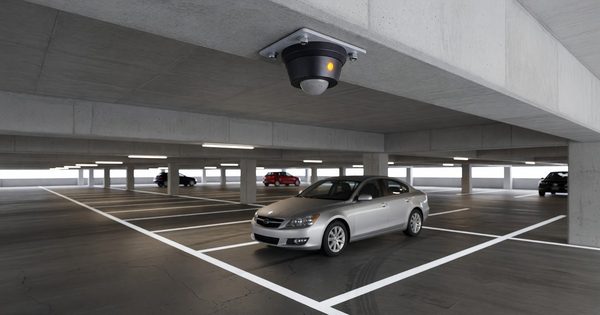
The shift from dedicated per-space sensors to camera-based detection isn’t just a cost story — it’s a capability story. A camera covering eight parking spaces is simultaneously doing eight occupancy detections, but it’s also capturing visual data that enables capabilities that binary occupancy sensors can’t support:
Vehicle classification. Deep learning models can classify vehicles by type (sedan, SUV, pickup truck, motorcycle, commercial vehicle) with high accuracy. This enables space management applications like motorcycle-only sections, oversized vehicle identification, and EV vehicle identification that supports charge management.
Dwell time and turnover analytics. Per-space sensor data tells you that a space is occupied; camera data with vehicle classification and optionally LPR can tell you which vehicle has been in that space, for how long, enabling enforcement workflows (overstay detection) and analytics (turnover rate by space, by time of day, by day of week) that per-space sensors can’t generate.
Anomaly detection. Computer vision models can be trained to detect unusual situations: vehicles parked in non-spaces, vehicles parked across multiple stalls, blocked fire lanes, abandoned vehicles, or debris in driving aisles. These anomalies don’t register in per-space occupancy systems but are operationally significant.
Pedestrian and Safety Analytics
This is the application area that has generated the most interest from facility managers in the past two years, and for good reason. Parking structures are high-risk environments for pedestrian-vehicle conflicts, and camera coverage that exists for security purposes can be augmented with computer vision to provide active safety monitoring.
Wrong-Way Detection
Wrong-way driving in parking structures is a genuine safety hazard and a surprisingly common occurrence in complex multi-level facilities. Computer vision systems can detect vehicles traveling in the wrong direction in one-way aisles, triggering alerts to operators who can intervene via intercom or dynamic signage.
The technical challenge in wrong-way detection is direction discrimination — distinguishing a vehicle backing out of a space (normal behavior) from a vehicle traveling the wrong way down the aisle (hazardous). Modern models have become reliable enough at this distinction for operational deployment, though fine-tuning to a specific facility’s geometry is typically required during commissioning.
Pedestrian Behavior Analysis
Pedestrian heat mapping — computer vision analysis of camera footage to identify where pedestrians walk and where they dwell — reveals facility design issues that aren’t apparent from operational observation. Areas where pedestrians consistently walk in driving aisles (because the pathway design fails them), bottlenecks at elevator lobbies during peak periods, and routes that should have but don’t have striped crosswalks: all visible in aggregate pedestrian behavior data.
This analysis is distinct from real-time safety monitoring — it’s a design and operations input rather than an active alert system. Facility managers who commission periodic computer vision analysis of pedestrian behavior data are using a tool that didn’t exist five years ago.
Incident Detection
Computer vision can be configured to detect specific visual events: vehicle impacts (sudden motion changes consistent with collision), objects in roadways, and people-down scenarios (someone who has fallen and isn’t moving). These applications are more technically challenging than occupancy detection because the training data for relatively rare events is limited, increasing false positive rates.
The commercial applications in parking are still maturing. Vendors make broad claims; due diligence requires asking specifically about false positive rates in production deployments — not in demo environments with curated scenarios.
Security and Access Applications
Credential-Free Access
The combination of LPR and permit database integration enables frictionless access for credentialed vehicles: a permit holder drives in, the camera reads the plate, the system verifies the permit, and the gate opens — no ticket, no RFID card, no interaction required.
This “virtual credential” approach is production-ready and widely deployed. The extension of this concept to payment — plate-linked payment accounts where entry and exit are automatic and the payment is charged to a registered account — is also commercially available from multiple vendors.
Security Watchlists and BOLO Integration
LPR-based security monitoring connects parking cameras to watchlists of vehicles of interest — law enforcement BOLO (Be On the Lookout) lists, internal security flagging, or theft investigation databases. When a flagged plate is read, security personnel are alerted in real time.
The privacy and legal implications of this capability vary significantly by jurisdiction. Some states have specific regulations governing LPR data retention and watchlist integration. Any deployment of LPR for security watchlist purposes should involve legal review of applicable state and local requirements.
Predictive Analytics: The Frontier Application
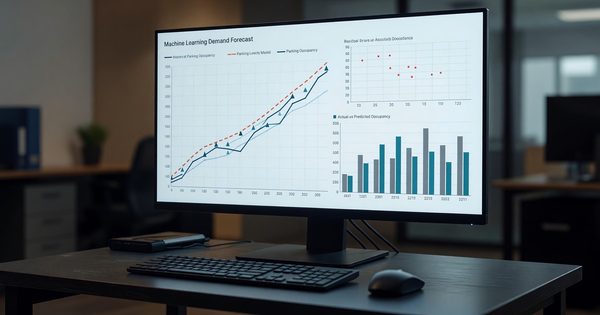
The most forward-looking computer vision applications in parking use historical visual data to predict future conditions. Demand prediction models trained on historical occupancy patterns can forecast when facilities will reach capacity, enabling proactive management responses: dynamic pricing adjustments, variable message sign updates, or staff scheduling.
These applications require meaningful data history — typically at least six months of high-quality occupancy data — before predictions are useful. They also require machine learning infrastructure that most parking operators don’t maintain in-house, which is driving a category of parking analytics SaaS platforms that provide predictive insights as a managed service layer on top of existing sensor and camera infrastructure.
The connection between computer vision-generated parking data and broader smart city transportation management is a developing area with significant long-term potential. smartparkingworld.org is one of the better resources for tracking how parking data feeds into city-scale mobility intelligence — the integration between parking occupancy prediction and traffic signal timing is an active research area with early commercial deployments in several mid-size cities.
Evaluating Computer Vision Vendors
The gap between what computer vision can do in controlled conditions and what it reliably does in production parking environments is real. Evaluation criteria for any computer vision parking application:
Training data provenance. What dataset was the model trained on? How representative is it of your facility type, climate, and vehicle mix? A model trained predominantly on warm-weather, clear-sky data may underperform in overcast northern climates.
Edge vs. cloud processing. Where does the inference run? Edge processing (on a device at the facility) has lower latency and doesn’t depend on network connectivity. Cloud processing offers more computational resources and potentially more frequent model updates. The right answer depends on application latency requirements and connectivity environment.
Accuracy metrics in production, not demos. Ask for precision and recall figures from production deployments in conditions similar to yours. Precision measures false positive rate; recall measures false negative rate. High precision and high recall are both required for useful detection — a model that minimizes false positives by being conservative about positive detections has high precision but low recall.
For a broader perspective on how computer vision fits within the parking technology stack, the industry analysis resources at parkingprofessional.com cover this technology category with practitioner perspective that complements vendor documentation.
Computer vision in parking is past the hype stage for the core applications — LPR, occupancy detection, basic security monitoring — and entering a stage of genuine operational maturity. The more sophisticated applications (behavioral analytics, predictive demand, pedestrian safety) are real and deployable, but require more careful evaluation of vendor maturity and alignment to specific facility conditions. The facilities that will get the most from this technology are the ones that approach it as a data infrastructure investment rather than a product purchase.